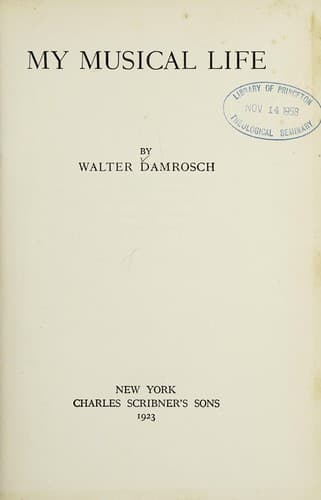
Conductors (Music) -- United States -- Biography; Damrosch, Walter, 1862-1950
On my return to Chaumont I outlined this idea to several officers of the
Staff and of the French Commission, who received it with enthusiasm and
promised every assistance, but, alas, nothing ever came of it. When I
returned to France the following spring the armistice had been arranged
and the Versailles Conference was dragging its weary and dreary
deliberations toward an unsatisfactory conclusion. There did not seem to
be enough illusion or enthusiasm left to celebrate anything
international connected with the war.
On my last visit to Chaumont I gave a little dinner to Colonel Collins,
secretary of the Staff, whose constant interest had been invaluable and
whose mind seemed to be capable at a moment’s notice of turning from the
consideration of some intricate military problem to the great advantages
to be derived from the introduction of the French B-flat bugle into our
army. Over a very good magnum of champagne I rose and made him, Colonel
Boyd, and Lieutenant Weill solemnly swear that for the rest of the war
and as long thereafter as necessary the bandmaster’s school at Chaumont
should be to them as the apple of their eye, and this oath they
faithfully kept. The school flourished from October, 1918, until June,
1919, when it was discontinued owing to the return of our army to
America. The relations between the French professors and our boys, all
living together like a happy family, became so sympathetic and intimate
that the results may truly be said to have been remarkable. The soldiers
realized that they were receiving an education in music equal to that of
the foremost schools of France or America, and the French professors
entered into their duties with an enthusiasm which was touching.
Casadesus told me that many of his pupils worked at their musical
problems twelve hours a day and I urged him, in some way or other, to
continue these pleasant and important international musical relations by
founding a summer school somewhere in France, preferably near Paris, to
which American men and women, already sufficiently advanced in their
study of music, could repair for three months every summer in order to
acquaint themselves with French art and French methods of teaching.
Until the war began, hundreds of American students had gone to Germany
every year, and it seemed a pity that, owing to the Frenchman’s lack of
propaganda for what his country could offer to our students, some of
this stream could not be diverted to France. Our talks eventually led to
the founding of the _Conservatoire Américain_ at Fontainebleau, of which
details are told in another chapter.
Public-domain text, read in full here on John Shaqi.
Reviews
Reviews
No reviews yet
Be the first to share your thoughts on this work.
Elsewhere in the archive
Join the Discussion
Join the discussion
Sign in to leave a comment or review.
Sign InorCreate an account