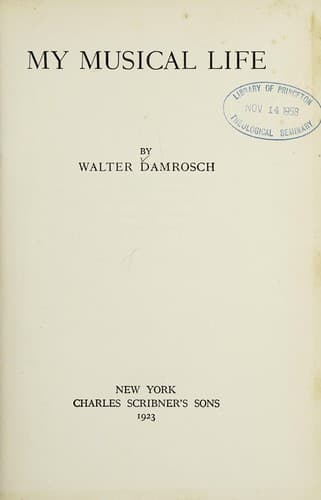
Conductors (Music) -- United States -- Biography; Damrosch, Walter, 1862-1950
It was delightful to hear the half-suppressed “Ah’s” and “Bravos!” so
characteristic of the French audience after the Andante of the Mozart
Symphony. I confess that the more spontaneous approval which European
audiences give in drama, opera, or concert is exceedingly gratifying and
stimulates the artist to the very best that is in him. Every artist who
is worth his salt will always approach an audience with the feeling that
they are as strangers whom through his art he must win over as friends.
This feeling exists whether he makes his first bow as a beginner or
appears for the three thousandth time after twenty years of public work.
It is a wonderful moment for him when, after having done his best and
given all there is in him, his audience show by the intensity of their
approval that the “song which he breathed into the air” has found its
home “in the heart of a friend.”
On Sunday morning, May 9, at eleven, the orchestra of the Conservatoire
gave a great party in our honor as a return courtesy for one that we had
given to the French Orchestra on their arrival in America in 1918. We
all met at the _Salle du Conservatoire_ where M. Leon, representing the
Ministry of Fine Arts, was waiting to receive me. With the Conservatoire
Orchestra were various French masters, including the venerable Gabriel
Fauré, and Messager, the conductor.
After various speeches of welcome, I was presented with a beautiful
engraving of Beethoven and made an honorary member of the Conservatoire
Orchestra. We then marched to the _Taverne du Nègre_, where luncheon was
served. There were so many different kinds of wine-glasses before each
plate that I asked permission to make a short speech in English to my
orchestra. It consisted of the following:
“Gentlemen, remember we have a concert this afternoon, so please mix
your wine with much water.”
Needless to say, in all the speeches the theme of the war was constantly
played upon by the French orators—how much France owed to our
intervention and to the bravery of our soldiers.
It would have been very pleasant to stay on in Paris, where our
orchestra were beginning to feel very much at home, and rest upon our
young laurels, but our tour had only begun and we had to carry on!
Public-domain text, read in full here on John Shaqi.
Reviews
Reviews
No reviews yet
Be the first to share your thoughts on this work.
Elsewhere in the archive
Join the Discussion
Join the discussion
Sign in to leave a comment or review.
Sign InorCreate an account