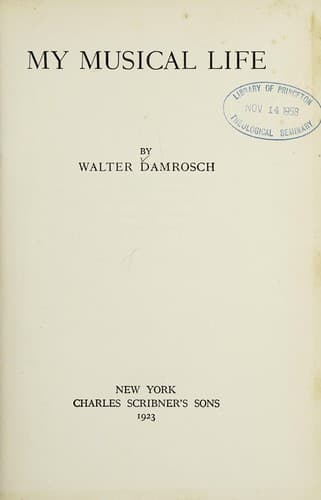
Conductors (Music) -- United States -- Biography; Damrosch, Walter, 1862-1950
The next morning Engles brought me a telegram which he had just received
from our general manager in Paris, to the effect that at Marseilles the
hall in which we were to play had been condemned by the fire department
as unsafe, and that therefore the concert would have to be given at
another theatre and under different management. Engles did not like the
look of things and begged me, as he could not speak French, to go with
him to Marseilles and look over the ground with him. We were to have
played in Marseilles under the auspices and management of the local
symphonic organization, which, however, turned out to be but a small and
not very influential body of musicians, most of whom were amateurs.
Their secretary, who was to attend to the details of management, was a
newspaper man and an amateur double-bass player, of which instrument he
was very proud. When we arrived, only two days before the concert, we
found that absolutely nothing had been done to advertise it. There were
no posters, no advertisements, and the manager of the theatre to which
we had been transferred did not even know before our arrival whether we
were a jazz band of colored people from America or perhaps a troupe of
wandering minstrels.
We were to give two concerts, and at first it seemed as if, under such
disheartening circumstances, it were better to cancel them and proceed
to Monte Carlo and Italy, where already sold-out houses awaited us. The
newspaper man, who was the real delinquent, was nowhere to be found. He
had gone to the country “_pour se reposer_” and was not expected until
the following day. Luckily the theatre manager proved to be of the right
sort. When he saw what our organization really stood for he would not
hear of cancellation, and immediately went around to all the newspaper
offices with Engles. Posters, the principal method of advertising in
Europe, appeared on the street corners as if by magic; and while it was
too late to attract a large audience for the first concert, he assured
us that if this concert were the success which he expected, the theatre,
which held about twenty-four hundred people, would be entirely sold out
for the second concert on Sunday afternoon. His prophecy proved correct.
There were not more than eight hundred people at the first concert, but
as they were real sons of the _Midi_ and as they had never heard a
symphonic organization of such size and importance in their lives, they
went mad. They applauded with their hands, with both feet, with their
canes and umbrellas. They shouted in eight-part harmonies and the
rafters of the theatre trembled in sympathy. After the concert they
lined up at the box-office in a great crowd while the theatre manager,
grinning from ear to ear, said: “Did I not tell you?”
Public-domain text, read in full here on John Shaqi.
Reviews
Reviews
No reviews yet
Be the first to share your thoughts on this work.
Elsewhere in the archive
Join the Discussion
Join the discussion
Sign in to leave a comment or review.
Sign InorCreate an account