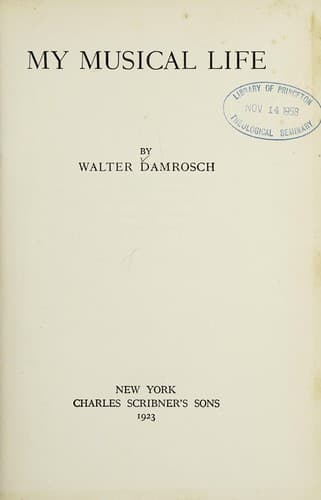
Conductors (Music) -- United States -- Biography; Damrosch, Walter, 1862-1950
After we got back to the hotel the great iron doors were suddenly closed
and bolted, for quite a riot started in front of it. The trolley company
was trying to run a car through the city, manned by young mechanics from
the School of Technology, and every once in a while a mob of strikers
would rush at them, break the windows of the car, and pull off the young
strike-breakers. But it was all done in rather an amiable fashion, while
a crowd of men in light straw hats applauded with their hands and
shouted “Bravo,” all as if it were a performance gotten up for their
pleasure. Then a couple of amiable gendarmes would come along and in the
same placid fashion place the young men on the car again, which would
then proceed for another few yards or so. Suddenly, however, this
seeming comedy took a tragic turn. The mob made a vicious lunge; they
were stopped by the police who suddenly acted with great energy, and
soon there were several men seriously hurt. In the meantime the
strike-breakers had again connected their car with the electric wire,
and although the car with its broken windows looked a perfect wreck, it
moved triumphantly along the tracks and the strike was broken. Next
morning every car was running again.
Later that afternoon I received a visit from Morris Tivin, the first
double-bass player of our orchestra. He brought with him a boy of
fifteen, a little Russian Jew, who had a most remarkable history. He had
escaped from a prison in Russia and worked his way to Constantinople. As
he was a violinist of exceptional ability, he had made a meagre living
there playing in the cafés. Having read in some old Paris paper that we
were to give a concert in Marseilles he had quickly made up his mind to
get there and perhaps through our help reach the promised land of
America. He arrived in Marseilles as a stowaway after incredible
hardships, and when he introduced himself to some of his Russian
compatriots in my orchestra, he was literally starving and without a
cent in his pockets. Within a few hours our orchestra had subscribed
enough money to send him to New York with several letters to their
colleagues at the Musical Union, and within a week after his arrival he
was engaged as second concert master at a large salary in one of our
Western orchestras.
The generous spirit displayed by our men, which demonstrated itself in
so quick and practical a fashion, is characteristic of the rank and file
of our profession. I have never known a case of an orchestra musician or
chorus singer in need that his colleagues were not immediately ready to
help, and as their own earnings are comparatively small their generosity
is much greater in proportion than that of many a rich man whose name
figures largely among the subscribers to our charitable organizations.
Public-domain text, read in full here on John Shaqi.
Reviews
Reviews
No reviews yet
Be the first to share your thoughts on this work.
Elsewhere in the archive
Join the Discussion
Join the discussion
Sign in to leave a comment or review.
Sign InorCreate an account