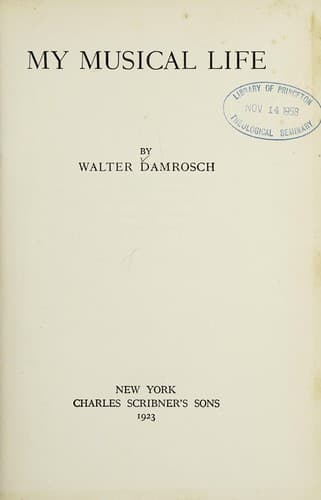
Conductors (Music) -- United States -- Biography; Damrosch, Walter, 1862-1950
“Why in heaven’s name did you not tell me this sooner?” I said to my
friend, but he simply smiled his inscrutable Italian smile and lit
another cigarette. With the resolve to do or die, I marched along with
them to a private room in a restaurant adjoining the Gardens and there
ices and vermuth were served to the members of the two musical
organizations, and I was presented with the gold Roman medal, which I
treasure very highly as coming from so remarkable a body of players as
the Banda Communale di Roma.
For some years I have been interested in the new musical development
that is going on in Italy. There had been a period when her church music
led the world in the variety and beauty of its form. Later on,
especially in the eighteenth century, she had produced many composers of
distinction in instrumental music, but from then on and until very
recent times, opera had almost completely monopolized her writers. The
splendid opera-houses which are to be found in her smallest towns are
eloquent testimony to the important place which that form of art
occupies in the hearts of the Italian people. Every Italian can sing,
and the critics and lovers of opera are to be found just as much among
the poorer classes as among the aristocracy.
But all the testimony of older musicians with whom I have spoken and who
have travelled through Italy is to the effect that her orchestras
formerly were of a very poor quality. Their playing was slovenly and
rehearsals few and insufficient. Many of the players in the opera-houses
of even the larger cities followed some other calling in the daytime,
and there was many a tailor or shoemaker who played his violin in the
evening at the opera.
Within the last twenty-five years, however, a complete and almost
miraculous change has come over musical conditions throughout Italy. Its
conservatories in Rome, Milan, Bologna, and Naples turn out excellent
players, and several of her conductors rank with the best of other
countries. Signor Mancinelli, for instance, who was my colleague during
the years that I conducted at the Metropolitan for Maurice Grau, was a
first-class musician and conductor, well versed in more than Italian
music. He was a great lover of Mozart and gave beautiful performances of
the “Magic Flute” at the Metropolitan. He envied me my job of conducting
the Wagner operas and later on conducted many of them in Italy and
Spain.
Toscanini is one of the greatest conductors living to-day. His range
extends to the music of all countries, and I have heard him conduct
Mozart’s “Don Giovanni,” Verdi’s “Falstaff,” and Wagner’s
“Meistersinger” in one week with equal penetration into their beauties
and, incidentally, without an orchestral score in front of him. He has
made a virtue of necessity, as he is almost blind and has therefore
developed his power of memory to a greater extent than I have ever seen
in any other musician, not even excepting Hans von Bülow.
Public-domain text, read in full here on John Shaqi.
Reviews
Reviews
No reviews yet
Be the first to share your thoughts on this work.
Elsewhere in the archive
Join the Discussion
Join the discussion
Sign in to leave a comment or review.
Sign InorCreate an account