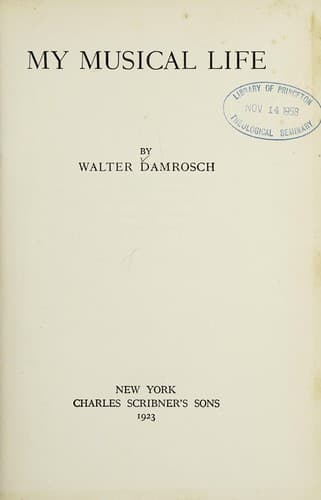
Conductors (Music) -- United States -- Biography; Damrosch, Walter, 1862-1950
The result of this has been that the cultural life of American women has
often been absolutely a thing apart from their relations with their
men-folk. It has become accepted that of course men do not and need not
share the women’s interest in the arts; and while business does not
perhaps monopolize the American man in quite as unhealthy a fashion as
in former years, the principal change which has been brought about is
the introduction of golf, at least an occupation in which men and women
may share. What a pity that the elusive ball is not composed of a little
Beethoven and Brahms instead of the mysterious mixture of concrete and
gutta-percha, and that family life, which is the very fortress of
civilization, cannot make use of the cultivation of music as one of the
strongest ties to bind husband and wife, sons and daughters together!
Some of us are too prone to look upon modern plumbing, telephones, and
motor-cars as evidences of high civilization or even culture, when they
are really only more or less agreeable conveniences which minister to
our comfort but not to our heart or head.
In Europe men and women share more equally in the love and cultivation
of music, and the emotional and personal attitude of the women is offset
by the more impersonal and mental attitude of the men. The result of
this is shown in audiences in which neither sex predominates and, above
all, in the cultivation of chamber-music at home in which professionals
and amateurs, men and women, participate to their mutual pleasure and
development. Nothing more charming can be imagined than such family
evenings of music, during which the players indulge themselves in the
string quartets and piano trios of Mozart, Beethoven, and Brahms, with
perhaps a small audience of enthusiasts composed of other members of the
family and half a dozen friends who afterward all join in a jolly supper
of bread and cold meats, together with a good bottle of wine or beer.
My father carried this lovely custom into the New World, and I owe
almost my entire education in chamber-music to the Sunday afternoons at
his house, the tranquil and spiritual atmosphere of which is
unforgettable.
A few years ago a meeting was held in the mayor’s office at City Hall at
which I had been asked to speak in behalf of good music for the people
on Sunday afternoons and evenings. A clergyman from Brooklyn had made a
tremendous appeal against any Sunday recreations and wanted the aldermen
to revive the old blue laws of two hundred years ago. The room was
crowded with people, and when I spoke of what the chamber-music on
Sunday afternoons at my father’s house had meant to me as a boy, this
audience broke into such enthusiastic applause that there was no
mistaking the general attitude, and my Sunday symphony concerts, which I
was the first to inaugurate in New York, have only once been interfered
with by municipal authorities.
Public-domain text, read in full here on John Shaqi.
Reviews
Reviews
No reviews yet
Be the first to share your thoughts on this work.
Elsewhere in the archive
Join the Discussion
Join the discussion
Sign in to leave a comment or review.
Sign InorCreate an account