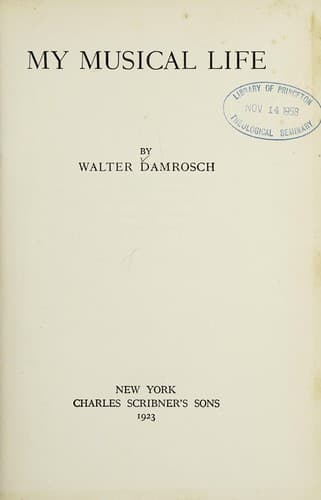
Conductors (Music) -- United States -- Biography; Damrosch, Walter, 1862-1950
The Greek choruses usually begin with a recital of some old story of
mythology, with which every Greek in the audience of that era had been
familiar since childhood. Gradually this story is brought into
connection with the situation on the stage and reaches its climax when
the chorus implores the actors to draw their lesson from it. These
choruses I treated in various ways, according to the needs of the
dramatic situation. Some were recited to a soft but expressive
undercurrent of music, others were sung, and still others were a
combination of both. I would have the story of the old Greek legend
recited by the first leader of the chorus. Then the second leader, as he
applied it to the dramatic situation, would burst into song, until, in
the third phase, the entire chorus would join in their impassioned
pleadings or warnings.
In the spring of 1915 I took a little cottage in Setauket, Long Island,
and there within six weeks wrote the entire music for the two plays, the
orchestra parts being copied sheet by sheet as my score was finished. In
June I packed them in my bag and travelled across the continent to meet
Margaret Anglin and take charge of the musical part of the production.
On arriving in San Francisco I found the great World’s Fair already in
full operation. Its Spanish architecture and the luxuriant verdure in
which it was enclosed made it a perfect dream of beauty, but I gave
myself little opportunity to enjoy it, as my real mission was across the
bay at the Greek Theatre in Berkeley, where Margaret Anglin and a
company of players were already busily engaged from morning till evening
in rehearsing. They were anxiously awaiting my music in order to make it
fit in properly with the stage arrangements.
The Greek Theatre at the California University is one of the most
remarkable structures of its kind in the world. Built amphitheatrically
against the side of a hill and absolutely on the lines of the old Greek
theatres, its top is fringed by sombre eucalyptus-trees.
A few years before I had seen a performance of the “Bacchante” of
Euripides given by a company of Roman actors at an antique amphitheatre
on the side of a hill overlooking Florence. Much of this performance had
been impressive, but the music was tawdry, and as the play was given
according to old Greek custom in the late afternoon, the cruel sunlight
made the make-up of the actors and the garish colors of their costumes
doubly prosaic. The ancient Greeks had no artificial lighting and were
therefore compelled to give their performances in daylight, although
they sought to temper it so that night would fall at about the end of
the play. Margaret Anglin, with her characteristic genius, perceived
that a much greater glamour and stage illusion could be produced by
giving her performances at night, leaving the audience in darkness and
marking out the stage with great electric lights from above, which could
be heightened or lessened according to the actual needs of the drama.
Public-domain text, read in full here on John Shaqi.
Reviews
Reviews
No reviews yet
Be the first to share your thoughts on this work.
Elsewhere in the archive
Join the Discussion
Join the discussion
Sign in to leave a comment or review.
Sign InorCreate an account