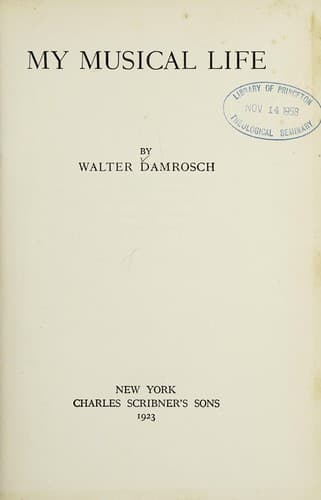
Conductors (Music) -- United States -- Biography; Damrosch, Walter, 1862-1950
Miss Anglin had enlisted the services of fourteen of California
University’s loveliest and most talented coeds to form her Greek chorus.
Beauty seems to flourish naturally on the Pacific coast, and some of
these young ladies were glorious specimens of a truly Greek and
statuesque charm. The recitation of one of the choruses, which was to be
spoken in a kind of elastic rhythm to the music of the orchestra, was
intrusted to one of these Dianas of Berkeley, and as she had no
conception of this, to her, novel combination, Miss Anglin asked me to
give her a separate rehearsal after lunch. I sat down at the piano and
recited the chorus to her while I played the accompanying music. She
stood by my side listening intently and looking like a statue of Diana
of Ephesus. Then, bending her head with stately dignity, she said: “I
get ya!” Alas! the illusion was gone, and her voice brought me back
suddenly from my dream of 400 B. C. to California of 1915. She had not
“got me,” however, and I was finally compelled to give this chorus to
another young lady, less statuesque in form but more clever in achieving
plastic unity between speech and music.
But my real troubles began when I tried to collect an orchestra of fifty
for the performances. At that time there were not many good players in
San Francisco, and even those few were permanently engaged in the big
World’s Fair orchestra. My first rehearsal was truly pathetic—I had
been so spoiled by the many years of association with my lovely New York
Symphony Orchestra. But where there is a will there is a way, and by
stealing a few men from the local theatres and borrowing a few more from
the exposition orchestras, we were enabled to get a fairly good body of
men assembled.
The success of Miss Anglin’s productions was truly remarkable. There
were ten thousand people at each performance, and “Iphigenia in Aulis”
had to be repeated twice. In this work the camp of _Agamemnon_ and its
atmosphere of war were graphically illustrated, and five hundred
Berkeley students, picturesquely attired and well trained, gave a very
vivid picture of the soldier’s camp, especially at the end of the play
when the Oracle has announced that the wind has changed, and these
hundreds of soldiers rushed across the stage in a tumult of joy to board
their ships and sail for Troy.
The “Electra,” for which William Furst had written music for Miss Anglin
years before, was also performed. Eventually I also composed music for
this play, and all three of the dramas were performed in New York a few
years later at the request of Mr. Flagler, on the stage of Carnegie
Hall, which had been skilfully converted for the occasion into a Greek
theatre.
Public-domain text, read in full here on John Shaqi.
Reviews
Reviews
No reviews yet
Be the first to share your thoughts on this work.
Elsewhere in the archive
Join the Discussion
Join the discussion
Sign in to leave a comment or review.
Sign InorCreate an account