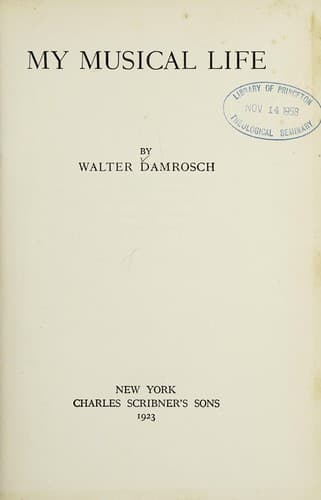
Conductors (Music) -- United States -- Biography; Damrosch, Walter, 1862-1950
I was a boy of fifteen when I heard the first performance of “Lohengrin”
at the old Academy of Music. The opera was sung in Italian with Italo
Campanini as _Lohengrin_, Valeria as _Elsa_, and our own Anne Louise
Cary as _Ortrude_. The conductor was old Luigi Arditi. I sat in the
front row in the family circle, and was so excited by the drama and the
music that at the end of the double male chorus—which accompanies the
approach of _Lohengrin_ in the boat drawn by the swan as the God-sent
deliverer of _Elsa_—the tears rushed down my cheeks. But they were
happy tears and a natural relief from the tension which the music had
created in me.
Each succeeding opera of Wagner’s was a similar revelation. I pored over
the scores of the “Nibelungen Trilogy” during every hour left me from
school work and piano practice. In fact, I often stole time from the
latter and would gladly have given up my entire school if my parents had
not very properly kept me where I belonged. Later on my founding of the
Damrosch Opera Company for the sole purpose of producing Wagner operas
seemed an inner necessity, and I was driven to it by a force stronger
than myself. For years a Wagner programme, whether it was at a symphony
concert in New York, or in Oklahoma on a Western tour, or at the Willow
Grove summer concerts, drew the largest audiences, and the same
orchestral excerpts were repeated by me and other conductors year after
year and received by our public with excited enthusiasm. To-day the
amazement which his music called forth is no longer apparent. He is
admired and loved, but the nerves of the younger generation are not
thrilled by his harmonies as ours were. His works repose upon our
shelves bound in morocco and gold and occupy places of honor, but, alas,
on several of them the dust is beginning to gather and many of the young
people of to-day find “Lohengrin” monotonous, and vote unanimously that
_Tannhäuser’s_ recital of his pilgrimage to Rome is too long.
Time and continued occupation with Wagner’s music may have made me more
critical and analytical, and I am no longer in complete and enthusiastic
accord with some of his theories regarding the music-drama. But much of
his music still sweeps me off my feet, and his “Meistersinger”—which is
so happy and perfect a compromise between the opera and the
music-drama—is to me still the greatest musical work of our times.
I have spoken above of the finality of the judgment of the public
regarding the ultimate vitality of an art work. Conductors have had
their personal convictions and have tried to force them upon our
audiences, but unless these convictions were based on actual worth the
public has in the end consciously or unconsciously rejected them.
Sometimes unworthy composers have had momentary popularity, but they
were born but to dance in the sun for one day and then to die.
Public-domain text, read in full here on John Shaqi.
Reviews
Reviews
No reviews yet
Be the first to share your thoughts on this work.
Elsewhere in the archive
Join the Discussion
Join the discussion
Sign in to leave a comment or review.
Sign InorCreate an account