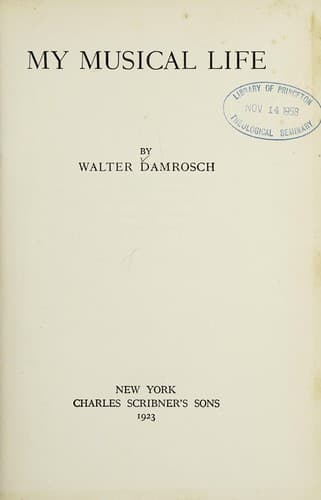
Conductors (Music) -- United States -- Biography; Damrosch, Walter, 1862-1950
Another fellow guest was Doctor Sturgis Bigelow, an enthusiastic admirer
of Madame Ternina’s art, who had come to New York especially to be
present at all of her appearances. She was to have made her farewell to
America in the “Götterdämmerung” and Doctor Bigelow had ordered enough
flowers from half a dozen of the florists of Broadway and Fifth Avenue
to fill the entire Academy, but unfortunately Madame Ternina became ill
and her place had to be taken at the last moment by her rival, Madame
Klafsky. Doctor Bigelow had no desire to present the floral testimony of
his adoration to this rival singer, and therefore proceeded on the
difficult task of cancelling his many orders, but as many of the wreaths
and lyres had already been prepared, his bill for “damages” was quite
large.
Before Ternina sailed for home she told me that she intended to stay
away for a few years. I had paid her five hundred dollars an appearance
which was a fair honorarium at that time, as she was absolutely unknown
and therefore had not yet developed a sufficient “drawing power” to
warrant a higher fee, but she said she would not come back to America
until she could command a fee of a thousand dollars. This decision she
adhered to, and when she did return a few years later, Maurice Grau
cheerfully paid her the thousand dollars and she was immediately
proclaimed one of the greatest _Isoldes_ of our time.
My New York season opened on March 4, 1896, with Beethoven’s “Fidelio.”
The audience was a distinguished one, containing a great many of the old
Academy habitués. Grand opera had not been given there since 1888, when
the tenor, Italo Campanini, had brought over an Italian opera company.
Of Klafsky I have already spoken, but my new barytone, Dimitri Popovici,
also made a sensation. I had found him in Bayreuth, where he had sung
_Telramund_ and _Kurvenal_.
I produced my own opera, “The Scarlet Letter,” during the second week,
and the reception accorded it was more than cordial. As the Symphony
Society of New York wished to present me with an exquisitely bound copy
of Hawthorne’s “The Scarlet Letter” as a memento, Richard Welling, the
secretary and an old friend, suggested to Anton Seidl, who was in the
audience, that he be spokesman, but as he refused Welling presented the
book to me himself.
While the balance-sheet of the five months’ season showed a “loss of
forty-three thousand dollars,” the larger part of my gains of the year
before, I cannot say that my wife and I were very much cast down. Youth
is optimistic, and the loss of money is, in itself, not such a dreadful
calamity if one still has enough to pay one’s debts; and all this time I
was adding to my experience and artistic stature.
Public-domain text, read in full here on John Shaqi.
Reviews
Reviews
No reviews yet
Be the first to share your thoughts on this work.
Elsewhere in the archive
Join the Discussion
Join the discussion
Sign in to leave a comment or review.
Sign InorCreate an account