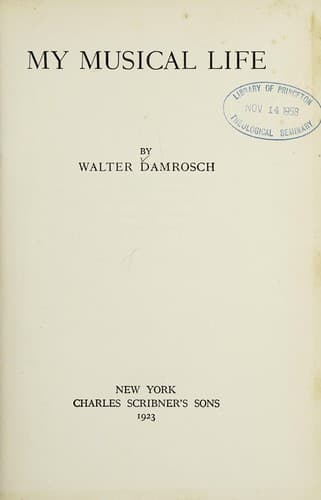
Conductors (Music) -- United States -- Biography; Damrosch, Walter, 1862-1950
I recall that when he was a member of my opera company I paid him two
hundred and fifty dollars an appearance, with about twelve appearances a
month guaranteed, but he insisted that in the written contract I should
make it only two hundred dollars an appearance and give him the other
fifty in cash. He used this subtle method in order to have about six
hundred dollars a month spending money of which his wife should know
nothing. It was I who had to endure the complaints from her, which ran
something like this: “I do not know why my Emil is so badly paid while
all the others get these enormous salaries. My Emil sings better than
any of them and he has to be content with only two hundred dollars an
appearance!” And I would sit by feeling very guilty, and yet, from that
horrid loyalty which one man has for another, not daring to exculpate
myself by condemning him.
At one time in Chicago I accompanied him into a haberdasher’s shop as he
wished to buy a necktie. He selected one the price of which was two
dollars and a half, and then superbly handed the astonished clerk a
five-dollar bill, saying grandiloquently: “You may keep the change!”
He was a great gourmet, and every now and then would give a banquet at
his house to his fellow artists, with interminable courses and all
manner of wines. Needless to say he did not save anything from his
earnings and there came years, as he grew older and his voice left him,
when he had to turn to teaching. But he never changed his habits and his
appearance was just as carefully gotten up as in former years. Finally
came the time when he was really in want, and I assisted Mr. Flagler,
who was also an old admirer of his, in getting up a benefit for him at
the Metropolitan Opera House. The directors very generously gave the use
of the house, many of the stockholders bought their boxes, and the
climax of the performance was the appearance of dear old Fischer in his
greatest rôle of _Hans Sachs_ in the third act of “Die Meistersinger.” A
very good sum was realized with which we bought an annuity for him. He
was then, I believe, seventy-four (his wife had died several years
before), and a ten-year annuity seemed to us the best way of taking care
of him without giving him an opportunity to squander his money. He was
delighted, and the first thing he did on the strength of his new wealth
was to marry a young lady from the chorus, who, however, I believe took
excellent care of him until he died.
Public-domain text, read in full here on John Shaqi.
Reviews
Reviews
No reviews yet
Be the first to share your thoughts on this work.
Elsewhere in the archive
Join the Discussion
Join the discussion
Sign in to leave a comment or review.
Sign InorCreate an account