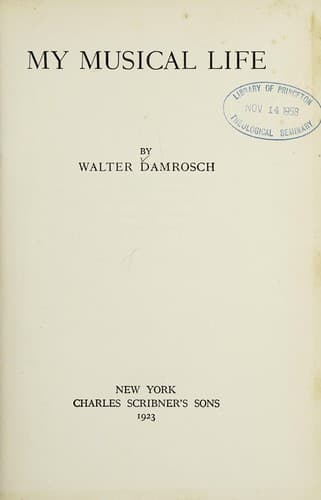
Conductors (Music) -- United States -- Biography; Damrosch, Walter, 1862-1950
In 1909 I gave a Beethoven cycle at which I performed all the Beethoven
symphonies and other smaller works of his in historical sequence. We had
engaged Ysaye to play the Beethoven Violin Concerto, but, to my
astonishment, he sent word only a week before that he must first play a
violin concerto by Vitali, as he had to get his fingers into proper
condition before playing the Beethoven. I remonstrated with him and
explained to him that in a Beethoven cycle I could not possibly give a
concerto by Vitali, even to oblige Ysaye, and suggested that he play the
Vitali concerto to himself in the greenroom before the concert, but he
refused to accept this amendment and I was ever so reluctantly compelled
to cancel his appearance in the cycle. This caused a coolness between us
which lasted several years and which I regretted exceedingly. But time
is a great peacemaker. We happened to meet again quite casually a few
years later, and by tacit consent this little contretemps was completely
buried and we are as good friends as of yore.
Perhaps the most important and interesting great musician of France whom
I have known was Camille Saint-Saëns, whom I met in 1908 when he came to
America on a concert tour. He was at that time seventy years of age. His
extraordinary vitality and the fluency of his playing amazed us all, and
America outdid itself to honor this venerable _grand maître_. I had the
great pleasure of conducting all of his concerts in New York at which he
played his five piano concertos, an extraordinary feat for a man of his
age. We had heard so many stories from French musicians of his “nasty
temper” at rehearsals and his caustic comments on this or that phrasing
in his symphonies or concertos that we were all very agreeably
disappointed in finding him genial, cheerful, and grateful for what we
were able to give him. He even insisted on playing the organ himself at
my performance of his Symphony No. 3, which is dedicated to the memory
of Liszt. I have always considered this to be his greatest work in that,
with all the clarity of form and diction which is a special
characteristic of his style, there is also a deep emotion which rises in
the last movement to a triumphant and thrilling climax.
I saw him again in Paris during the war in the summer of 1918, and
reminded him of a visit which my father had paid to him in 1876.
“That was not the first time I met your father,” he quickly rejoined. “I
remember very well meeting him in Weimar in 1857 while I was visiting
Liszt.”
Public-domain text, read in full here on John Shaqi.
Reviews
Reviews
No reviews yet
Be the first to share your thoughts on this work.
Elsewhere in the archive
Join the Discussion
Join the discussion
Sign in to leave a comment or review.
Sign InorCreate an account