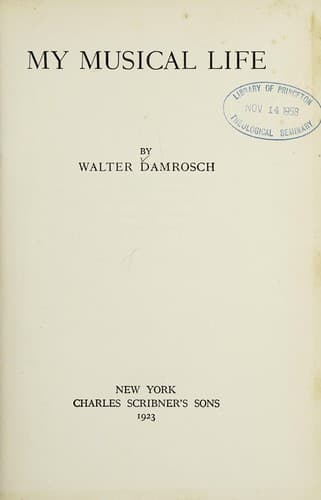
Conductors (Music) -- United States -- Biography; Damrosch, Walter, 1862-1950
“This is the way it should be played,” said Saint-Saëns, as he sat down
at the piano and proceeded to let his fingers, though still clad in gray
lisle gloves, run up the keys with incredible swiftness, like little
gray mice. This extreme dexterity never left him. I had heard him but a
month before at a musical given by Widor in his honor and in which
Saint-Saëns played the piano part in his own “Septet with Trumpet.” His
fingers literally ran away with him, and every time there was a quick
passage, he accelerated the tempo to such an extent that the other
players simply had to scramble after him as best they could.
He died last winter at eighty-four years of age, and all Paris,
governmental, artistic, and scientific, united in giving him imposing
and significant obsequies. The respect which the young men of France
have for their old masters is something exceedingly sympathetic to an
American observer. Whenever Saint-Saëns appeared among them they would
hover around with eager deference, flushing with pride as he would say
something to the one or the other. In fact, Widor, who is perhaps ten
years younger than Saint-Saëns, always insisted on treating him as if
he, Widor, were a young, deferential schoolboy in the presence of his
great master. Indeed, they reserve the words “_grand maître_” only for
their very choicest men of the arts and the learned professions.
With Lillian Nordica I made a joint tour through New England, giving
Wagner concerts. As she had by that time arrived at true prima donna
estate she had a private car in which she lived and in which I also had
a room. The poor lady arrived on the first day with an attack of
bronchitis so acute that she could hardly speak. Her voice sounded like
the croak of a raven. I have never seen any woman in such abject
despair, walking up and down the little dining-room of the car like a
caged tigress, every now and then touching a note on the upright piano
which had been placed therein, and trying her voice. She was clad in a
wrapper, and tears and misery had ravaged her comely face so that it was
hardly recognizable. I, of course, thought that she would not sing that
evening, but at seven she disappeared into her room and an hour later
emerged clad in a magnificent toilet, with her diamond tiara on the top
of her head and her face wonderfully made up. When she appeared before
her audience with whom she was an old favorite, her manner had all the
regal but smiling charm of yore. Her voice? Well, that is another story.
During that entire week this tragi-comedy would repeat itself every day.
Her bronchitis never left her, and from my room I could hear this poor
woman, as she entered the dining-room, touch the piano furtively and try
to sing a few notes. It was agony, and I have hated private cars ever
since, and am quite content to occupy a drawing-room or a berth in a
regular sleeping-car when I travel. It is certainly more cheerful.
Public-domain text, read in full here on John Shaqi.
Reviews
Reviews
No reviews yet
Be the first to share your thoughts on this work.
Elsewhere in the archive
Join the Discussion
Join the discussion
Sign in to leave a comment or review.
Sign InorCreate an account