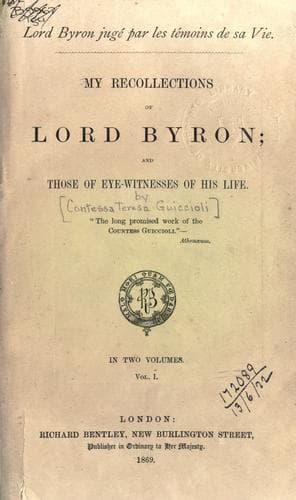
My Recollections of Lord ByronGuiccioli, Teresa, contessa di
General
My Recollections of Lord Byron
Guiccioli, Teresa, contessa di
Byron, George Gordon Byron, Baron, 1788-1824; Poets, English -- 19th century -- Biography
_Stanza_ 153.
* * * * * * *
"Christ's mighty shrine above his martyr's tomb!"
_Stanza_ 154.
"But thou, of temples old, or altars new,
Standest alone, with nothing like to thee.
* * * * * * *
Power, glory, strength, and beauty all are aisled
In this eternal ark of worship undefiled."
From Venice he went on to Ravenna. The persecution to which he was
subjected, on the ground of religion and morality, on account of the
publication of the two first cantos of "Don Juan," was then at its
height, and he was tormented in every possible way. It was useless for
him to protest, in verse, in prose, by letter, or by words, against the
accusation of his being an atheist and a skeptic. It was asserted that
"Manfred" was the expression of his doubts upon the dispensation of
Providence, and that his other poems, all more or less imbued with
passion, had tendencies of an irreverent nature in respect to the
Divinity. His two famous stanzas in "Childe Harold" were always held up
to him by the innumerable army of hypocrites and wicked people who
assailed him.
All were not hypocrites, however; some were his enemies in good faith,
but were blinded by sectarian prejudices. Among these was an Irishman of
the name of Mulock, author of a work entitled "Atheism Answered." Lord
Byron one day at Ravenna received a paper from the editor of the
"Bologna Telegraph," with extracts from this work, in which "there is a
long eulogium of" his "poetry, and a great _compatimento_ for" his
"misery" on account of his being a skeptic and an unbeliever in Christ;
"although," says Mr. Mulock, "his bold skepticism is far preferable to
the pharisaical parodists of the religion of the Gospel, who preach and
persecute with an equally intolerant spirit."
Lord Byron, writing that day to Murray, says:--
"I never could understand what they mean by accusing me of irreligion.
They may, however, have it their own way. This gentleman seems to be my
great admirer, so I take what he says in good part, as he evidently
intends kindness, to which I can't accuse myself of being insensible."
Public-domain text, read in full here on John Shaqi.
Reviews
Reviews
No reviews yet
Be the first to share your thoughts on this work.
Elsewhere in the archive
Join the Discussion
Join the discussion
Sign in to leave a comment or review.
Sign InorCreate an account