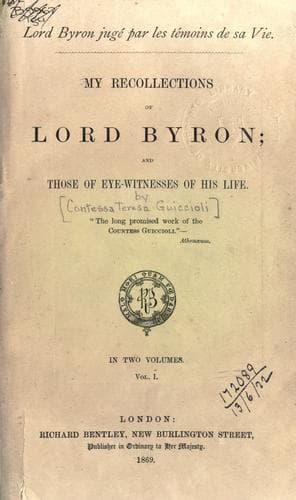
My Recollections of Lord ByronGuiccioli, Teresa, contessa di
General
My Recollections of Lord Byron
Guiccioli, Teresa, contessa di
Byron, George Gordon Byron, Baron, 1788-1824; Poets, English -- 19th century -- Biography
The Bible, as is well known, constituted his favorite reading. Often did
he find in the magnificent poetry of the Bible matter for inspiration.
His "Hebrew Melodies" prove it, and as for the Book of Job, he used to
say that it was far too sublime for him even to attempt to translate it,
as he would have wished. Toward the end of his stay at Ravenna, when his
genius was most fertile and almost superhuman--(he wrote five dramas and
many other admirable poems in fifteen months, that is to say, in less
time than it requires to copy them)--two biblical subjects inspired his
muse: "Cain," and "Heaven and Earth." Both were admirably suited to his
pen. He naturally treated them as a philosopher, but without any
preconceived notion of making any religious converts. His enemies
nevertheless seized hold of these pieces, to incriminate him and impugn
his religious belief. I have spoken elsewhere[19] of that truly
scandalous persecution. I will only add here that Moore, timid as he
usually was when he had to face an unpopularity which came from high
quarters, and alarmed by all the cries proceeding from party spirit,
wrote to approve the beauty of the poem in enthusiastic terms, but
disapproved of the harm which some doubts expressed therein might
produce. Byron replied:--
"There is nothing against the immortality of the soul in 'Cain,' that I
recollect. I hold no such opinions; but in a drama the first rebel and
the first murderer must be made to talk according to his character."
And in another letter he says, with regard to the same subject:--
"With respect to religion, can I never convince you that I have no such
opinions as the characters in that drama, which seem to have frightened
every body? Yet they are nothing to the expressions in Goethe's 'Faust'
(which are ten times hardier), and not a whit more bold than those of
Milton's 'Satan.' My ideas of character may run away with me: like all
imaginative men, I, of course, embody myself with the character while I
draw it, but not a moment after the pen is from off the paper.
"I am no enemy to religion, but the contrary. As a proof, I am educating
my natural daughter a strict Catholic in a convent of Romagna, for I
think people can never have enough of religion, if they are to have any.
I incline myself very much to the Catholic doctrines; but if I am to
write a drama, I must make my characters speak as I conceive them likely
to argue."
The sympathy of persons sincerely religious was extremely agreeable to
him. A short time after he had left Ravenna for Pisa, a Mr. John
Sheppard sent him a prayer he had found among the papers belonging to
his young wife, whom he had lost some two years before. Lord Byron
thanked him in a beautiful letter, in which he consoled the distressed
husband by assuring him of his belief in immortality, and of his
confidence that he would again see the worthy person whom himself he
could not but admire, for her virtues and her pure and simple piety.
Public-domain text, read in full here on John Shaqi.
Reviews
Reviews
No reviews yet
Be the first to share your thoughts on this work.
Elsewhere in the archive
Join the Discussion
Join the discussion
Sign in to leave a comment or review.
Sign InorCreate an account