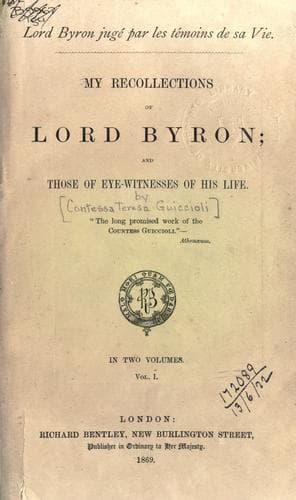
My Recollections of Lord ByronGuiccioli, Teresa, contessa di
General
My Recollections of Lord Byron
Guiccioli, Teresa, contessa di
Byron, George Gordon Byron, Baron, 1788-1824; Poets, English -- 19th century -- Biography
He then added, that in his youth he had been brought up by his mother in
very strict religious principles; had read a large number of theological
works, and that Barrow's writings had most pleased him; that he
regularly went to church, that he was by no means an unbeliever who
denied the Scriptures, and wished to grope in atheism; but, on the
contrary, that all his wish was to increase his belief, as
half-convictions made him wretched. He declared, however, that he could
not thoroughly understand the Scriptures. He also added, that he
entertained the highest respect for, and confidence in, those who
believed conscientiously; but that he had met with many whose conduct
differed from the principles they professed simply from interested
motives, and esteemed the number of those who really believed in the
Scriptures to be very small. He asked him about his opinion as to
various writers against religion, and among others of Sir W. Hamilton,
Bellamy, and Warburton, who pretend that the Jews had no notion of a
future existence. He confessed that the sight of so much evil was a
difficulty to him, which he could not explain, and which made him
question the perfect goodness of the Creator. He dwelt upon this
argument a long time, exhibiting as much tenderness of heart as force of
reasoning. Kennedy's answers were weak, as must be those of one who
denies the measure of evil, in order that he may not be compassionate
toward it, and who promises a reward in after life to escape the
necessity of its being bestowed in the present. In reply Lord Byron
pointed to moral and physical evil which exists among savages, to whom
Scripture is unknown, and who are bereft of all the means of becoming
civilized people. Why are they deprived of these gifts of God? and what
is to be the ultimate fate of Pagans? He quoted several objections made
to our Lord by the apostles; mentioned prophecies which had never been
fulfilled, and spoke of the consequences of religious wars. Kennedy
replied with much ability, and even with a certain degree of eloquence,
and prudently made use of the ordinary theological arguments. But to
influence such a mind as Byron's more was required. In the search after
truth, he looked for hard logic, and eloquence was not required by him.
Fenelon could not have persuaded him; but Descartes might have
influenced him. He preferred, in fact, in such arguments, the method of
the geometrician to that of the artist; the one uses truth to arrive at
truth, the other makes use of the beautiful only, to arrive at the same
end.
Public-domain text, read in full here on John Shaqi.
Reviews
Reviews
No reviews yet
Be the first to share your thoughts on this work.
Elsewhere in the archive
Join the Discussion
Join the discussion
Sign in to leave a comment or review.
Sign InorCreate an account