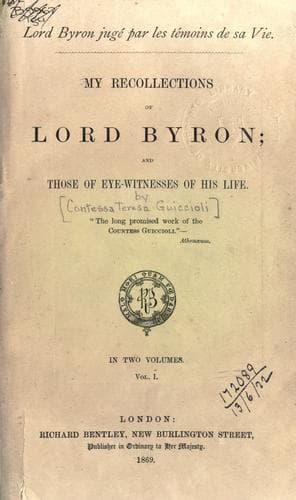
My Recollections of Lord ByronGuiccioli, Teresa, contessa di
General
My Recollections of Lord Byron
Guiccioli, Teresa, contessa di
Byron, George Gordon Byron, Baron, 1788-1824; Poets, English -- 19th century -- Biography
This predilection for Catholicism was not the result of the poetry of
that religion, or of the effect which its pomps and gorgeous ceremonies
produced upon the imagination. They, no doubt, were not indifferent to a
mind so easily impressed as his, but not sufficient to justify his
preference; for Byron, although a poet, never allowed his reason to be
swayed by his imagination. He reasoned upon every subject. His
objections proceeded as much from his mind as his heart. "Catholicism,"
he was wont say, "is the most ancient of worships; and as for our own
heresy, it unquestionably had its origin in vice. With regard to those
difficulties which baffle our understanding, are they more easily
explained by Protestants than by Catholics?
"Catholicism, at least, is a consoling religion, and its belief in
Purgatory conciliates the justice of the Almighty with His goodness. Why
has Protestantism given up so human a belief? To intercede for and do
good to beings whom we have loved here below, is to be not altogether
separated from them."
"I often regretted," he said on one occasion at Pisa, "that I was not
born a Catholic. Purgatory is a consoling doctrine. I am surprised that
the Reformers gave it up, or that they did not at least substitute for
it something equally consoling." "It is," he remarked to Shelley, "a
refinement of the doctrine of transmigration taught by your stupid
philosophers."
It was, therefore, chiefly this doctrine, and his abhorrence of Calvin,
which attracted Byron toward Catholicism. A comparison was made before
him, on one occasion, between Catholicism and Protestantism. "What
matters," said Byron, "that Protestantism has decreased the number of
its obligations, and reduced its articles of faith? Both religions
proceed from the same origin,--authority and examination. It matters
little that the measures of either be different; but why does the
Protestant deny to the Catholic the privilege, which he claims more than
he uses, of free examination? Catholics also claim the right of proving
the soundness of their belief, and, therefore, admit likewise the right
of discussion and examination. As for authority, if the Catholic obeys
the Church and considers it infallible, does not the Protestant do the
same with the Bible? And while recognizing the authority of the Church
on the one hand, on the other he claims a right to free examination,
does he not incur the liability of being thought inconsistent? And,
after all, is not the authority of the Church the better of the two?
There seems to greater peace for the mind who confides in it, than in
the belief in the authority of a book, where one must ever seek the way
to salvation by becoming a theologian, as it were. And is it not fairer
to have certain books, such, for instance, as the 'Apocalypse,'
explained to us by the Church, than to have them expounded by people
more or less well informed or prejudiced?"
Public-domain text, read in full here on John Shaqi.
Reviews
Reviews
No reviews yet
Be the first to share your thoughts on this work.
Elsewhere in the archive
Join the Discussion
Join the discussion
Sign in to leave a comment or review.
Sign InorCreate an account