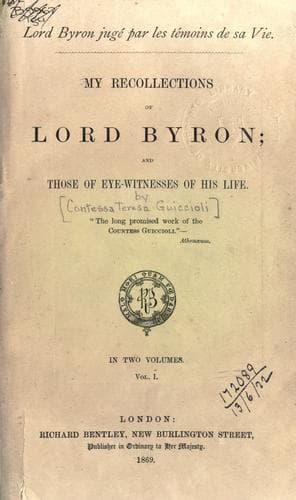
My Recollections of Lord ByronGuiccioli, Teresa, contessa di
General
My Recollections of Lord Byron
Guiccioli, Teresa, contessa di
Byron, George Gordon Byron, Baron, 1788-1824; Poets, English -- 19th century -- Biography
Although he showed at an early age his disposition to a poetical turn of
mind, by the force of his feelings and by his meditative wanderings--in
Scotland among the mountains and on the sea-shore at Cheltenham;--by his
rapturous admiration of the setting sun, as well as by the delight which
he took in the legends told him by his nurses, and the emotions which he
experienced to a degree which made him lose all appetite, all rest, and
all peace of mind; yet no one would have believed at that time that a
gigantic poetical genius lay dormant in so active a nature. Soon,
however, did his soul light up his intelligence, and obliged him to have
recourse to his pen to pour out his feelings. From that moment his
genius spread its roots in his heart, and Harrow became his paradise
owing to the affection which he met with there.
It was at Harrow that he wrote, between his fourteenth and eighteenth
year, the "Hours of Idleness, by a Minor," of which he had printed at
the request of his friends, a few copies for private circulation only.
These modest poems did not, however, escape the brutal attacks of
critics. Mackenzie, however, a man of talent himself, soon discovered
that at the bottom of these poems there lay the roots of a great
poetical genius. The "Hours of Idleness" are a treasure of intellectual
and psychological gleanings. They showed man as God created him, and
before his noble soul, depressed by the insolence of his enemies and the
troubles of life, endeavored to escape the eyes of the world, or at
least of those who could not or would not understand him.
The noblest instincts of human nature shine so conspicuously in the
pages of this little volume, that we thank God that he created such a
noble mind, while we feel indignant toward those who could not
appreciate it. But to understand him better he must reveal himself, and
we shall therefore quote a few of his own sayings as a boy. His first
grief brought forth his first poem. A young cousin of his died, and of
her death he spoke to this effect in his memorandum:--
"My first recourse to poetry was due to my passion for my cousin
Margaret Parker. She was, without doubt, one of the most beautiful and
ethereal beings I ever knew. I have forgotten the lines, but never shall
I forget her. I was twelve years of age, and she was older than myself
by nearly a year. I loved her so passionately, that I could neither
sleep, nor get rest, or eat when thinking of her. She died of
consumption, and it was at Harrow that I heard both of her illness and
of her death."
Then it was that Byron wrote his first elegy, which he characterizes as
"very dull;" but it is interesting as his first poetical essay, and as
the first cry of pain uttered by a child who vents his grief in verse,
and reveals in it the goodness of his heart and the power of his great
mind. On a calm and dark night he goes to her tomb and strews it with
flowers; then, speaking of her virtues, exclaims:--
Public-domain text, read in full here on John Shaqi.
Reviews
Reviews
No reviews yet
Be the first to share your thoughts on this work.
Elsewhere in the archive
Join the Discussion
Join the discussion
Sign in to leave a comment or review.
Sign InorCreate an account