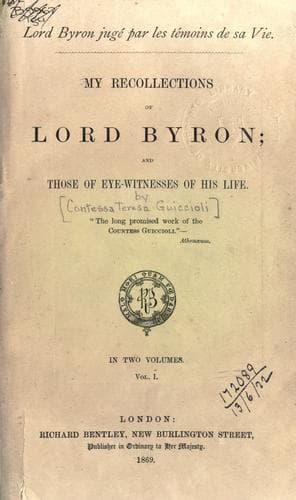
My Recollections of Lord ByronGuiccioli, Teresa, contessa di
General
My Recollections of Lord Byron
Guiccioli, Teresa, contessa di
Byron, George Gordon Byron, Baron, 1788-1824; Poets, English -- 19th century -- Biography
On his return to Harrow this love and his passionate friendships divided
his heart. But when the following vacation came, his dream vanished.
Miss Chaworth was engaged to another, and on his return to Harrow he
vainly tried to forget her who had deceived and wounded him. Like other
young men, he devoted his time during the Harrow or Cambridge vacations
to paying his respects and offering his regards to numerous belles,
whose names appear variously in his poems as Emma, Caroline, Helen, and
Mary. Moore believes them to have been imaginary loves. A slight
acquaintance with the liberty enjoyed by young men at English
universities would lead one to believe these loves to have been any
thing but unreal. This can be the more readily believed, as Byron always
sought in reality the objects which he afterward idealized. He always
required some earthly support, though the slightest, as Moore observes,
in speaking of the charming lines with which his love for Miss Chaworth
inspired him, at the time when the recollection of it made him compare
his misfortune in marrying Miss Milbank, with the happier lot which
might have been his had he married Miss Chaworth. Whether these loves
were real or not, however, it must be borne in mind that Byron deemed
all physical beauty to be nothing if unaccompanied by moral beauty.
Thus, in speaking of a vain young girl, he exclaims:--
"One who is thus from nature vain,
I pity, but I can not love."
And to Miss N. N----, who was exquisitely beautiful, but in whose eyes
earthly passion shone too powerfully, he says:--
"Oh, did those eyes, instead of fire,
With bright but mild affection shine,
Though they might kindle less desire,
Love, more than mortal, would be thine.
For thou art form'd so heavenly fair,
Howe'er those orbs may wildly beam,
We must admire, but still despair;
That fatal glance forbids esteem."
In a letter to Miss Pigott, which he wrote from Cambridge, he says:--
"Saw a girl at St. Mary's the image of Ann----; thought it was her--all
in the wrong--the lady stared, so did I--I blushed, so did _not_ the
lady--sad thing--wish women had more modesty."
On awaking from his dream, and on finding that the jewels with which he
had believed Mary's nature to be adorned were of his own creation, he
sought his consolation in friendship. His heart, which was essentially a
loving one, could not be consoled except by love, and Harrow, to use his
own expressions, became a paradise to him. In tracing the picture of
Tasso's infancy he has drawn a picture of himself:--
"From my very birth
My soul was drunk with love, which did pervade
And mingle with whate'er I saw on earth
Of objects all inanimate I made
Idols, and out of wild and lonely flowers,
And rocks, whereby they grew, a paradise
Where I did lay me down within the shade
Of waving trees, and dreamed uncounted hours,
Though I was chid for wandering...."
Public-domain text, read in full here on John Shaqi.
Reviews
Reviews
No reviews yet
Be the first to share your thoughts on this work.
Elsewhere in the archive
Join the Discussion
Join the discussion
Sign in to leave a comment or review.
Sign InorCreate an account