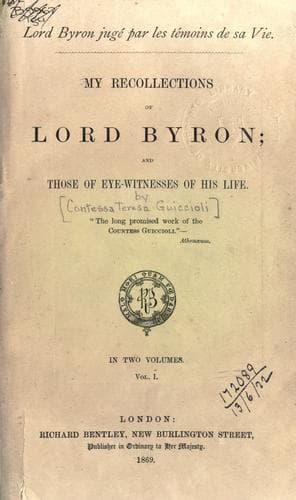
My Recollections of Lord ByronGuiccioli, Teresa, contessa di
General
My Recollections of Lord Byron
Guiccioli, Teresa, contessa di
Byron, George Gordon Byron, Baron, 1788-1824; Poets, English -- 19th century -- Biography
This eulogium is well deserved, and I pity those who could read the
"Hours of Idleness" without liking their youthful writer. If we had
space enough, we fain would follow the young man from Cambridge to the
mysterious Abbey of Newstead, where he loved to invite his friends and
institute with them a monastery of which he proclaimed himself the
Abbot--an amusement really most innocent in itself, and which bigotry
and folly alone could consider reprehensible. With what pleasure he
would show that in the monastery of Newstead its abbot lived the
simplest and most austere existence,--"a life of study," as Washington
Irving describes it, from what he heard Nanna Smyth say of it some
years after Byron's death. How delighted we should be to follow him in
his first travels in search of experience of life, and when his genius
revealed itself in that light which was shortly to make him the idol of
the public and the hatred of the envious. We could show him to have been
always the same kind-hearted man, by whom severity and injustice were
never had recourse to except against himself, and whose melancholy was
too often the result of broken illusions and disappointments. His simple
and noble character, having always before it an ideal perfection,
perpetually by comparison, thought itself at fault; and the world, who
could not comprehend the exquisite delicacy of his mind, took for
granted the reputation he gave himself, and made him a martyr till
heaven should give him time to become a saint.
FOOTNOTES:
[Footnote 20: See chapter upon Generosity.]
[Footnote 21: Marston Moor, where the adherents of Charles I. were
defeated. Prince Rupert, son of the Elector Palatine, and nephew to
Charles I. He afterward commanded the fleet in the reign of Charles II.]
[Footnote 22: This alludes to the public speeches delivered at the
school where the author was educated.]
[Footnote 23: Harrow.]
CHAPTER VI.
THE FRIENDSHIPS OF LORD BYRON.
The extraordinary part which friendship played in Lord Byron's life is
another proof of his goodness. His friendships may be divided into two
categories: the friendships of his heart, and those of his mind. To the
first class belong those which he made at Harrow and in his early
Cambridge days, while his later acquaintances at the University matured
into friends of the second category. These had great influence over his
mind. The names of those of the first category who were dearest to him,
and who were alive when he left Harrow for Cambridge (for he had lost
some very intimate friends while still at Harrow, and among these
Curzon), were--
WINGFIELD.
DELAWARE.
TATTERSALL.
CLARE.
LONG.
EDDLESTON.
HARNESS.
I will say a word of each, so as to show that Byron in the selection of
his friends was guided instinctively by the qualities of those he loved.
WINGFIELD.
Public-domain text, read in full here on John Shaqi.
Reviews
Reviews
No reviews yet
Be the first to share your thoughts on this work.
Elsewhere in the archive
Join the Discussion
Join the discussion
Sign in to leave a comment or review.
Sign InorCreate an account