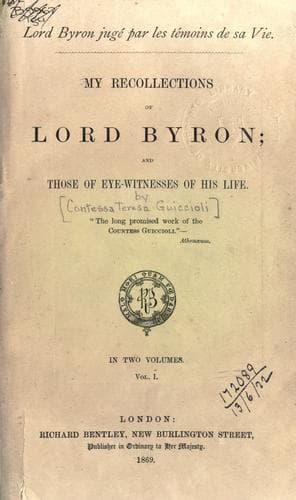
My Recollections of Lord ByronGuiccioli, Teresa, contessa di
General
My Recollections of Lord Byron
Guiccioli, Teresa, contessa di
Byron, George Gordon Byron, Baron, 1788-1824; Poets, English -- 19th century -- Biography
Dear Long, in this sequester'd scene,
While all around in slumber lie,
The joyous days which ours have been
Come rolling fresh on Fancy's eye;
Thus if amid the gathering storm,
While clouds the darken'd noon deform,
Yon heaven assumes a varied glow,
I hail the sky's celestial bow,
Which spreads the sign of future peace,
And bids the war of tempests cease.
Ah! though the present brings but pain,
I think those days may come again;
Or if, in melancholy mood,
Some lurking envious fear intrude,
To check my bosom's fondest thought,
And interrupt the golden dream,
I crush the fiend with malice fraught,
And still indulge my wonted theme.
Although we ne'er again can trace
In Granta's vale the pedant's lore;
Nor through the groves of Ida chase
Our raptured visions as before,
Though Youth has flown on rosy pinion,
And Manhood claims his stern dominion,
Age will not every hope destroy,
But yield some hours of sober joy.
Yes, I will hope that Time's broad wing
Will shed around some dews of spring:
But if his scythe must sweep the flowers
Which bloom among the fairy bowers,
Where smiling youth delights to dwell,
And hearts with early rapture swell;
If frowning age, with cold control,
Confines the current of the soul,
Congeals the tear of Pity's eye,
Or checks the sympathetic sigh,
Or hears unmoved misfortune's groan,
And bids me feel for self alone;
Oh, may my bosom never learn
To soothe its wonted heedless flow,
Still, still despise the censor stern,
But ne'er forget another's woe.
Yes, as you knew me in the days
O'er which Remembrance yet delays,
Still may I rove, untutor'd, wild,
And even in age at heart a child.
Though now on airy visions borne,
To you my soul is still the same.
Oft has it been my fate to mourn,
And all my former joys are tame.
But hence! ye hours of sable hue!
Your frowns are gone, my sorrows o'er:
By every bliss my childhood knew,
I'll think upon your shade no more.
Thus, when the whirlwind's rage is past,
And caves their sullen roar inclose,
We heed no more the wintry blast,
When lull'd by zephyr to repose.
Long's death was the cause of great grief to Lord Byron.
"Long's father," said he, "has written to ask me to write his son's
epitaph. I promised to do it, but I never had the strength to finish
it."
I will add that Mr. Wathen having gone to visit Lord Byron at Ravenna,
and having told him that he knew Long, Byron henceforth treated him with
the utmost cordiality. He spoke of Long and of his amiable qualities,
until he could no longer hide his tears.
In the month of October, 1805, Lord Byron left Harrow for Trinity
College, Cambridge, and in 1821 he thus described himself, and his own
feelings on leaving his beloved Ida for a new scene of life:--
Public-domain text, read in full here on John Shaqi.
Reviews
Reviews
No reviews yet
Be the first to share your thoughts on this work.
Elsewhere in the archive
Join the Discussion
Join the discussion
Sign in to leave a comment or review.
Sign InorCreate an account