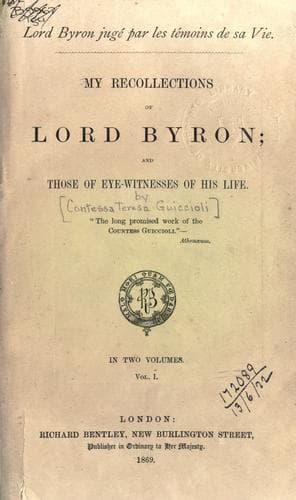
My Recollections of Lord ByronGuiccioli, Teresa, contessa di
General
My Recollections of Lord Byron
Guiccioli, Teresa, contessa di
Byron, George Gordon Byron, Baron, 1788-1824; Poets, English -- 19th century -- Biography
"But although he may for a time," says Moore, "have experienced this
kind of moral atomy, it was not in his nature to be long without
attaching himself to somebody, and the friendship which he conceived for
Eddleston--a man younger than himself, and not at all of his rank in
society--even surpassed in ardor all the other attachments of his
youth."
EDDLESTON
was one of the choristers at Cambridge. His talent for music attracted
Byron's attention. When he lost the society of Long, who had been his
sole comfort at Cambridge, he took very much to the company of young
Eddleston. One feels how much he was attached to him, on reading those
lines in which he thanks Eddleston for a cornelian heart he had sent
him:--
THE CORNELIAN.
No specious splendor of this stone
Endears it to my memory ever;
With lustre only once it shone,
And blushes modest as the giver.
Some, who can sneer at friendship's ties,
Have for my weakness oft reproved me;
Yet still the simple gift I prize,
For I am sure the giver loved me.
He offer'd it with downcast look,
As fearful that I might refuse it;
I told him, when the gift I took,
My only fear should be to lose it.
When Eddleston left college, Lord Byron wrote to Miss Pigott a letter
full of regret at having lost his youthful friend, and thanking her for
having taken an interest in him.
"During the whole time we were at Cambridge together," says Byron, "we
saw each other every day, summer and winter, and never once found a
moment of _ennui_, but parted each day with greater regret. I trust," he
added, at the end of his letter, "that you will some day see us
together; that is the being I esteem most, though I love several
others."
But in the year 1811 Eddleston died of consumption; and Lord Byron wrote
to Miss Pigott's mother, to beg of her to return the cornelian heart
which he had intrusted to her care, because it had "now acquired a value
which he wished it had never had;" the original donor having died at the
age of twenty-one, a few months before, and being "the sixth in the
space of four months of a series of friends and relations whom he had
lost since May."
The cornelian heart was restored, and Byron was informed that he had
only intrusted it, but not given it to Miss Pigott. It was on learning
of Eddleston's death that Byron added the touching ninth stanza to the
second canto of "Childe Harold."
After speaking of the hope of meeting again in a celestial abode, those
whom he loved on earth, and all those who taught the truth, he
exclaims,--
"There, thou!--whose love and life together fled,
Have left me here to love and live in vain--
Twined with my heart, and can I deem thee dead
When busy Memory flashes on my brain?
Well--I will dream that we may meet again,
And woo the vision to my vacant breast:
If aught of young Remembrance then remain,
Be as it may Futurity's behest,
For me 'twere bliss enough to know thy spirit blest!"
Public-domain text, read in full here on John Shaqi.
Reviews
Reviews
No reviews yet
Be the first to share your thoughts on this work.
Elsewhere in the archive
Join the Discussion
Join the discussion
Sign in to leave a comment or review.
Sign InorCreate an account