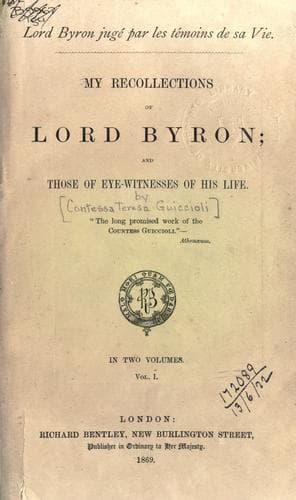
My Recollections of Lord ByronGuiccioli, Teresa, contessa di
General
My Recollections of Lord Byron
Guiccioli, Teresa, contessa di
Byron, George Gordon Byron, Baron, 1788-1824; Poets, English -- 19th century -- Biography
"To aid thy mind's development, to watch
Thy dawn of little joys, to sit and see
Almost thy very growth, to view thee catch
Knowledge of objects,--wonders yet to thee!
To hold thee lightly on a gentle knee,
And print on thy soft cheek a parent's kiss,
This, it should seem, was not reserved for me,
Yet this was in my nature: as it is,
I know not what is there, yet something like to this.
CXVIII.
* * * * * * *
"Sweet be thy cradled slumbers! O'er the sea
And from the mountains where I now respire,
Fain would I waft such blessing upon thee,
As, with a sigh, I deem thou might'st have been to me."
Who ever read "Childe Harold" and was not touched by the delightful
stanzas of the third canto,--a perfect _chef-d'oeuvre_ of tenderness
and kindness, inclosed, as it were, in another master-piece, like, were
it possible, a jewel found in a diamond?
Those only, however, who lived with him in Greece and in Italy are able
to bear witness to his paternal tenderness. This sentiment really
developed itself on his leaving England, and only appears from that time
forward in his poems. Byron loved all children, but his heart beat
really when he met children of Ada's age.
Hearing at Venice that Moore had lost a child, he wrote to him, "I enter
fully into your misery, for I feel myself entirely absorbed in my
children. I have such tenderness for my little Ada."
Both at Ravenna and at Pisa he was miserable if he did not hear from
Ada. Whenever he received any portraits of her or a piece of her hair,
these were solemn days of rejoicing for him, but they usually increased
his melancholy. When in Greece he heard of Ada's illness, he was seized
with such anxiety that he could no longer give his attention to any
thing. "His journal (which, by-the-by, was lost or destroyed after his
death) was interrupted on account of the news of his child's illness,"
says Count Gamba, in his narrative of Byron's last voyage to Greece.
The thought of his child was ever present to him when he wrote, and she
was the centre of all his hopes and his fears.
The persecution to which he was subjected for having written "Don Juan,"
having made him fear one day at Pisa that its effect upon his daughter
might be to diminish her affection for him, he said:--
"I am so jealous of my daughter's entire sympathy, that, were this work,
'Don Juan'--(written to while away hours of pain and sorrow),--to
diminish her affection for me, I would never write a word more; and
would to God I had not written a word of it!"
Public-domain text, read in full here on John Shaqi.
Reviews
Reviews
No reviews yet
Be the first to share your thoughts on this work.
Elsewhere in the archive
Join the Discussion
Join the discussion
Sign in to leave a comment or review.
Sign InorCreate an account