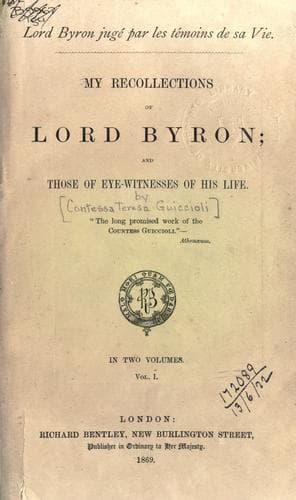
My Recollections of Lord ByronGuiccioli, Teresa, contessa di
General
My Recollections of Lord Byron
Guiccioli, Teresa, contessa di
Byron, George Gordon Byron, Baron, 1788-1824; Poets, English -- 19th century -- Biography
When he speaks of great men recently dead,--of Burke, Pitt, Burns,
Goldsmith, and others of his distinguished contemporaries,--he is
never-ending in his praise of them. His affectionate admiration for so
many went so far, almost, as to frighten him into the belief that it was
a weakness: after having said--"I like A----, I like B----. By
Mohammed!" he exclaims in his memoranda, "I begin to think I like every
body; a disposition not to be encouraged; a sort of social gluttony,
that swallows every thing set before it."
Not only was it a pleasure to him to praise those who deserved it, but
he would not allow the dead to be blamed, nor the illustrious among the
living; we all know how much he admired the talents of Madame de Stael:
"Il avait pour elle des admirations _obstinees_." "Campbell abused
Corinne," he says in his journal, 1813: "I reverence and admire him; but
I won't give up my opinion. Why should I? I read her again and again,
and there can be no affectation in this. I can not be mistaken (except
in taste) in a book I read and lay down and take up again; and no book
can be totally bad, which finds some, even _one_ reader, who can say as
much sincerely."
And elsewhere:
"H---- laughed, as he does at every thing German, in which, however, I
think he goes a little too far. B----, I hear, contemns it too. But
there are fine passages; and, after all, what is a work--any or every
work--but a desert with fountains, and, perhaps, a grove or two every
day's journey? To be sure, in mademoiselle, what we often mistake and
'pant for' as the 'cooling stream,' turns out to be the 'mirage'
(_critice_, verbiage); but we do, at last, get to something like the
temple of Jupiter Ammon, and then the waste we have passed is only
remembered to gladden the contrast."
He who was so sparing of answers to his own detractors, could not allow
a criticism against a friend to be left unanswered. We have seen how he
defended Scott, Shelley, Coleridge, and numerous other remarkable
persons, whenever they were unjustly attacked, although they were alive
to defend themselves. The respect and justice which he claimed for the
dead was equally proportioned. "Do not forget," he wrote to Moore on
hearing that he was about to write the "Life of Sheridan;" "do not
forget _to spare the living without insulting the dead_."
On reading, at Ravenna, that Schlegel said, that Dante was not popular
in Italy, and accused him of want of pathos: "'Tis false," said he, with
indignation; "there have been more editors and commentators (and
imitators ultimately) of Dante, than of all their poets put together.
_Not_ a favorite! Why they talk Dante, write Dante, and think and dream
Dante at this moment (1821) to an excess which would be ridiculous, but
that he deserves it.
"In the same style this German talks of gondolas on the Arno--a precious
fellow to dare to speak of Italy!
Public-domain text, read in full here on John Shaqi.
Reviews
Reviews
No reviews yet
Be the first to share your thoughts on this work.
Elsewhere in the archive
Join the Discussion
Join the discussion
Sign in to leave a comment or review.
Sign InorCreate an account