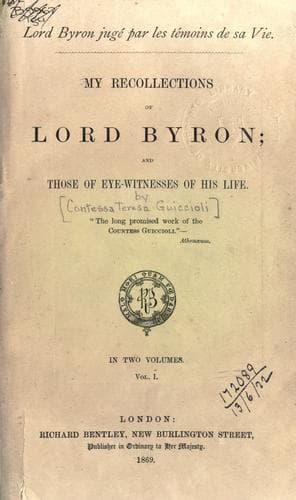
My Recollections of Lord ByronGuiccioli, Teresa, contessa di
General
My Recollections of Lord Byron
Guiccioli, Teresa, contessa di
Byron, George Gordon Byron, Baron, 1788-1824; Poets, English -- 19th century -- Biography
Mr. Pigott, a friend and companion of Byron's, who lived at Southwell,
in the neighborhood of Newstead, who travelled with Byron during his
holidays, told Moore that few people understood Byron; but that he knew
well how naturally sensitive and kind-hearted he was, and that there was
not the slightest particle of malignity in his whole composition. Mr.
Pigott, who thus spoke of Byron, was one of the most revered magistrates
of his county, and the head of that family with whom Byron was wont to
spend his holidays, and who loved him, both before and after his death,
as good people only can love and mourn. "Never," says Moore, "did any
member of that family allow that Byron had a single fault."
Mr. Lake, another biographer of Byron, says, "I have frequently asked
the country people what sort of a man Lord Byron was. The impression of
his eccentric but energetic character was evident in the reply. 'He's
the devil of a fellow for comical fancies--He flogs th' oud laird to
nothing, but he's a hearty good fellow for all that.'"
Here is Dallas's opinion, which can not be suspected of partiality, for
reasons which we have elsewhere given; for he believed himself
aggrieved, and considered as a great culprit the man who, ever so
slightly, could depart from the orthodox religious teachings; who had
not a blind admiration of his country; who could suffer his heart to be
possessed by an affection which marriage had not legitimatized; who
preferred to family pride the satisfaction of paying the debts
bequeathed to him by his ancestors, and who could make use of his right
of selling his lands. Yet, notwithstanding all this, Mr. Dallas
expresses himself to the following effect:--"At this time (1809), when
on the eve of publishing his first satire, and before taking his seat in
the House of Lords, I saw Lord Byron every day. (This was the epoch of
his misanthropy). Nature had gifted him with most amiable sentiments,
which I frequently had occasion to notice, and I have often seen these
imprint upon his fine countenance a really sublime expression. His
features seemed made expressly to depict the conceptions of genius and
the storms of passion. I have often wondered with admiration at these
curious effects. I have seen his face lighted up by the fire of poetical
inspiration, and, under the influence of strong emotions, sometimes
express the highest degree of energy, and at others all the softness and
grace of mild and gentle affection. When his soul was a prey to passion
and revenge, it was painful to observe the powerful effect upon his
features; but when, on the contrary, he was conquered by feelings of
tenderness and benevolence (which was the natural tendency of his
heart), it was delightful to contemplate his looks. I went to see Lord
Byron the day after Lord Falkland's death. He had just seen the
inanimate body of the man with whom, a few days before, he had spent
such an agreeable time. At intervals, I heard him exclaim to himself,
Public-domain text, read in full here on John Shaqi.
Reviews
Reviews
No reviews yet
Be the first to share your thoughts on this work.
Elsewhere in the archive
Join the Discussion
Join the discussion
Sign in to leave a comment or review.
Sign InorCreate an account