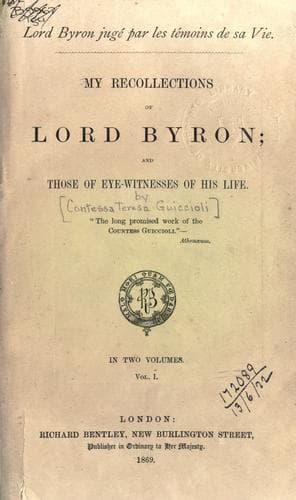
My Recollections of Lord ByronGuiccioli, Teresa, contessa di
General
My Recollections of Lord Byron
Guiccioli, Teresa, contessa di
Byron, George Gordon Byron, Baron, 1788-1824; Poets, English -- 19th century -- Biography
"One of the distinguishing excellences of Lord Byron," says one of his
best critics, "is that which may be found in all his productions,
whether romantic, classical, or fantastical, an intense sentiment of the
loveliness of woman, and the faculty, not only of drawing individual
forms, but likewise of infusing into the very atmosphere surrounding
them, the essence of beauty and love. A soft roseate hue, that seems to
penetrate down to the bottom of the soul, is spread over them."
More than any other genius, Lord Byron had the magic power of conjuring
up before our imagination the ideal image of his subject. He was not at
all perplexed how to clothe his ideas. That quality, so sought after by
other writers, and so necessary for hiding faults, was quite natural to
him. When he describes women, a few rapid strokes suffice to engrave an
indelible image on the mind of the reader. Let us take for examples:----
Leila, in the "Giaour."
Zuleika, in the "Bride of Abydos."
Medora, in the "Corsair."
Theresa, in "Mazeppa."
Haidee, in "Don Juan."
Adah, in "Cain."
The gentle Medora, ensconced within the solitary tower where she awaits
her Conrad, is fully portrayed in the melancholy song stealing on the
strings of her guitar, and in the tender, chaste words with which she
greets her lover.
Zuleika, the lovely, innocent, and pure bride of Selim, has her image
graven in the following fine lines:--
"Fair, as the first that fell of womankind,
When on that dread yet lovely serpent smiling,
Whose image then was stamp'd upon her mind--
But once beguiled--and evermore beguiling;
Dazzling, as that, oh! too transcendent vision
To Sorrow's phantom-peopled slumber given,
When heart meets heart again in dreams Elysian,
And paints the lost on Earth revived in Heaven;
Soft as the memory of buried love;
Pure, as the prayer which Childhood wafts above,
Was she--the daughter of that rude old Chief,
Who met the maid with tears--but not of grief.
"Who hath not proved how freely words essay
To fix one spark of Beauty's heavenly ray?
Who doth not feel, until his failing sight
Faints into dimness with its own delight,
His changing cheek, his sinking heart confess
The might, the majesty of Loveliness?
Such was Zuleika, such around her shone
The nameless charms unmark'd by her alone--
The light of love, the purity of grace,
The mind, the Music breathing from her face,
The heart whose softness harmonized the whole,
And, oh! that eye was in itself a Soul!
Her graceful arms in meekness bending
Across her gently-budding breast;
At one kind word those arms extending
To clasp the neck of him who blest
His child, caressing and carest."[48]
* * * * *
THERESA.
Public-domain text, read in full here on John Shaqi.
Reviews
Reviews
No reviews yet
Be the first to share your thoughts on this work.
Elsewhere in the archive
Join the Discussion
Join the discussion
Sign in to leave a comment or review.
Sign InorCreate an account