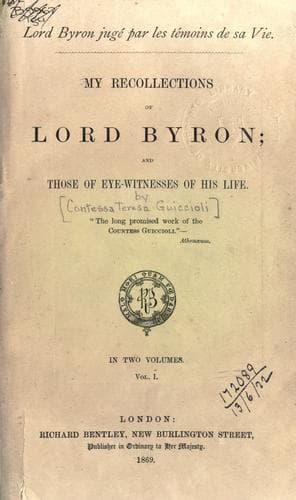
My Recollections of Lord ByronGuiccioli, Teresa, contessa di
General
My Recollections of Lord Byron
Guiccioli, Teresa, contessa di
Byron, George Gordon Byron, Baron, 1788-1824; Poets, English -- 19th century -- Biography
"Aurora Raby, a young star who shone
O'er life, too sweet an image for such glass;
A lovely being, scarcely form'd or moulded,
A rose with all its sweetest leaves yet folded;
* * * * * * *
"Early in years, and yet more infantine
In figure, she had something of sublime
In eyes which sadly shone, as seraphs' shine.
All youth--but with an aspect beyond time;
Radiant and grave as pitying man's decline;
Mournful--but mournful of another's crime,
She look'd as if she sat by Eden's door,
And grieved for those who could return no more."
And then:--
"She was a Catholic, too, sincere, austere,
As far as her own gentle heart allow'd."
And again:--
"She gazed upon a world she scarcely knew,
As seeking not to know it; silent, lone,
As grows a flower, thus quietly she grew,
And kept her heart serene within its zone.
There was awe in the homage which she drew:
Her spirit seem'd as seated on a throne
Apart from the surrounding world, and strong
In its own strength--most strange in one so young!"
* * * * * * *
"High, yet resembling not his lost Haidee;
Yet each was radiant in her proper sphere."
* * * * * * *
"The difference in them
Was such as lies between a flower and gem."
"_Don Juan_," canto xv.
Now that we have seen Lord Byron's ideal of womankind, let us mark with
what sentiments they inspired him, and in what way love always presented
itself to his heart or his imagination. Ever dealing out toward him the
same measure of justice and truth, people have gone on complacently
repeating that his love sometimes became a very frenzy, or anon
degenerated into a sensation rather than a sentiment. And his poetry has
been asserted to contain proof of this in the actions, characters, and
words of the persons there portrayed. I think, then, that the best way
of ascertaining the degree of truth belonging to these asseverations, is
to let him speak himself, on this sentiment, at all the different
periods of his life:--
"Yes, Love indeed is light from heaven;
A spark of that immortal fire
With angels shared, by Allah given
To lift from earth our low desire.
Devotion wafts the mind above,
But Heaven itself descends in love;
A feeling from the Godhead caught,
To wean from self each sordid thought;
A Ray of Him who form'd the whole;
A Glory circling round the soul!
I grant _my_ love imperfect, all
That mortals by the name miscall;
Then deem it evil, what thou wilt;
But say, oh say, _hers_ was not guilt!
She was my life's unerring light:
That quench'd, what beam shall break my night?"
"_The Giaour._"
Public-domain text, read in full here on John Shaqi.
Reviews
Reviews
No reviews yet
Be the first to share your thoughts on this work.
Elsewhere in the archive
Join the Discussion
Join the discussion
Sign in to leave a comment or review.
Sign InorCreate an account