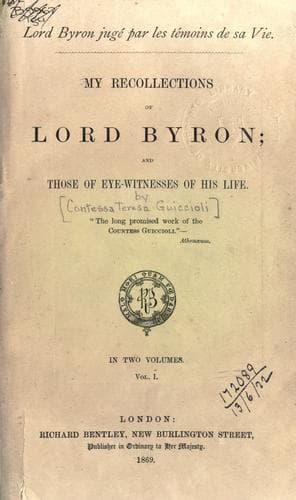
My Recollections of Lord ByronGuiccioli, Teresa, contessa di
General
My Recollections of Lord Byron
Guiccioli, Teresa, contessa di
Byron, George Gordon Byron, Baron, 1788-1824; Poets, English -- 19th century -- Biography
We have said enough of the female characters he created: sweet
incarnations of the most amiable qualities of heart and soul. Let us add
here, that although greatly alive to beauty of form, he could not
believe in a fine woman's delicate feeling, unless her beauty were
accompanied by expression denoting her qualities of heart and mind.
Beauty of form, of feature, and of color were nothing to him, if a woman
had not also beauty of expression; if he could not see, he said, beauty
of soul in her eyes. "Beauty and goodness have always been associated in
my idea," said he, at Genoa, to the Countess B----, "for in my
experience I have generally seen them go together. What constitutes true
beauty for me," added he, "is the soul looking through the eyes.
Sometimes women that were called beautiful have been pointed out to me
that could never in the least have excited my feelings, because they
wanted physiognomy, or expression, which is the same thing; while
others, scarcely noticed, quite struck and attracted me by their
expression of face."
He admired Lady C---- very much, because, he said, her beauty expressed
purity, peace, dreaminess, giving the idea that she had never inspired
or experienced aught but holy emotions. He once thought of marrying
another young lady, because she excited the same feelings. All the women
who more or less interested him in England were remarkable for their
intellect or their education, including her whom he selected for his
companion through life. Only, with regard to her, he trusted too much to
reputation and appearance; he saw what she had, not what was wanting.
She was in great part the cause of his deadly antipathy to regular "blue
stockings;" but that did not change the necessity of intellect for
exciting his interest. It only required, he said, for the _dress to hide
the color of the stockings_. The name he gave to his natural daughter
belonged to a Venetian lady, whose cleverness he admired, and with whom
his acquaintance consisted in a mere exchange of thought. Often he has
been heard to say that he could never have loved a silly woman, however
beautiful; nor yet a vulgar woman, whether the defect were the result of
birth, or education, or tastes. He felt no attraction for that style of
woman since called "fast." Even among the light characters whose
acquaintance he permitted to himself at Venice, he avoided those who
were too bold. There lived then at Venice Mme. V----, a perfect siren.
All Venice was at her feet; Lord Byron would not know her, and at
Bologna he refused to make acquaintance with a person of still higher
rank, Countess M----, who was both charming and estimable, but who had
the fault in his eyes of attracting too much general admiration. Her air
of modesty and reserve was what principally drew him toward Miss
Milbank. At Ferrara, where he met Countess Mosti and thought her most
delightful, he did not feel the same sympathy for her sister, who was,
Public-domain text, read in full here on John Shaqi.
Reviews
Reviews
No reviews yet
Be the first to share your thoughts on this work.
Elsewhere in the archive
Join the Discussion
Join the discussion
Sign in to leave a comment or review.
Sign InorCreate an account