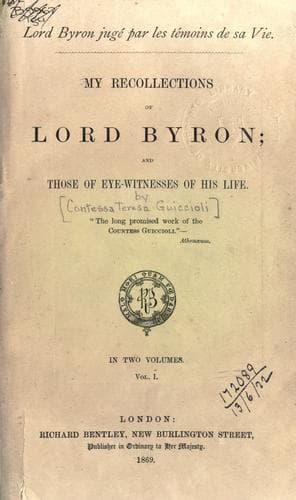
My Recollections of Lord ByronGuiccioli, Teresa, contessa di
General
My Recollections of Lord Byron
Guiccioli, Teresa, contessa di
Byron, George Gordon Byron, Baron, 1788-1824; Poets, English -- 19th century -- Biography
"He had grown fatter both in person and face, and the latter had most
suffered by the change--having lost by the enlargement of the features
some of that refined and spiritualized look that had in other times
distinguished it.... He was still, however, eminently handsome, and in
exchange for whatever his features might have lost of their high
romantic character, they had become more fitted for the expression of
that arch, waggish wisdom, that epicurean play of humor, which he had
shown to be equally inherent in his various and prodigally gifted
nature; while by the somewhat increased roundness of the contours the
resemblance of his finely-formed mouth and chin to those of the
Belvedere Apollo had become still more striking."[8]
Here are now the words of Lady B----, who saw him a few weeks only
before his last departure for Greece. This lady had conceived a totally
different idea of Byron. According to her, Byron would have appeared
affected, _triste_, in accordance with certain portraits and certain
types in his poems. But, if in order not to cause any jealousy among
the living, she dared not reveal all her admiration, she at least
suffered it to appear from time to time.
"There are moments," she says, "when Lord Byron's face is shadowed over
with the pale cast of thought, and then his head might serve as a model
for a sculptor or a painter to represent the ideal of poesy. His head is
particularly well formed: his forehead is high, and powerfully
indicative of his intellect: his eyes are full of expression: his nose
is beautiful in profile, though a little thickly shaped. His eyebrows
are perfectly drawn, but his mouth is perfection. Many pictures have
been painted of him, but the excessive beauty of his lips escaped every
painter and sculptor. In their ceaseless play they represented every
motion, whether pale with anger, curled in disdain, smiling in triumph,
or dimpled with archness and love."
This portrait can not be suspected of partiality; for, whether justly or
not, she did not enjoy Lord Byron's sympathy, and knew it; she had also
to forgive him various little circumstances which had wounded her "amour
propre," and was obliged to measure her praise in order not to create
any jealousy with certain people who surrounded him and who had some
pretension to beauty.
Here is the portrait of him which another lady (the Comtesse Albrizzi of
Venice) has drawn, notwithstanding her wounded pride at the refusal of
Lord Byron to allow her to write a portrait of him and to continue her
visits to him at Venice:--
Public-domain text, read in full here on John Shaqi.
Reviews
Reviews
No reviews yet
Be the first to share your thoughts on this work.
Join the Discussion
Join the discussion
Sign in to leave a comment or review.
Sign InorCreate an account