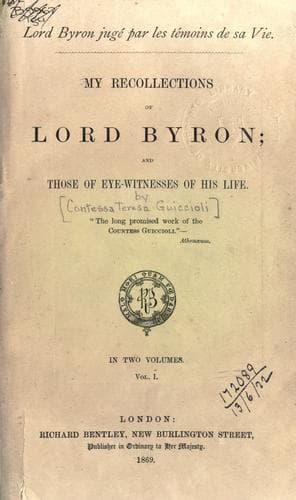
My Recollections of Lord ByronGuiccioli, Teresa, contessa di
General
My Recollections of Lord Byron
Guiccioli, Teresa, contessa di
Byron, George Gordon Byron, Baron, 1788-1824; Poets, English -- 19th century -- Biography
"What serenity on his forehead! What beautiful auburn, silken,
brilliant, and naturally curled hair! What variety of expression in his
sky-blue eyes! His teeth were like pearls, his cheeks had the delicate
tint of a pale rose; his neck, which was always bare, was of the purest
white. His hands were real works of art. His whole frame was faultless,
and many found rather a particular grace of manner than a fault in the
slight undulation of his person on entering a room. This bending of the
body was, however, so slight that the cause of it was hardly ever
inquired into."
As I have mentioned the deformity of his foot, even before quoting other
testimonies to his beauty, I shall tarry a while and speak of this
defect, the only one in so pre-eminently favored a being. What was this
defect, since all becomes illustrious in an illustrious man? Was it
visible? Was it true that Lord Byron felt this imperfection so keenly?
Here is the truth.
No defect existed in the formation of his limbs; his slight infirmity
was nothing but the result of weakness of one of his ankles.
His habit of ever being on horseback had brought on the emaciation of
his legs, as evinced by the post-mortem examination; besides which, the
best proof of this has been lately given in an English newspaper much to
the following effect:--
"Mrs. Wildman (the widow of the colonel who had bought Newstead) has
lately given to the Naturalist Society of Nottingham several objects
which had belonged to Lord Byron, and among others his boot and shoe
trees. These trees are about nine inches long, narrow, and generally of
a symmetrical form. They were accompanied by the following statement of
Mr. Swift, bootmaker, who worked for his lordship from 1805 to 1807.
Swift is still alive, and continues to reside at Southwell. His
testimony as to the genuineness of the trees, and to the nature of Lord
Byron's deformity, of which so many contradictory assertions have
circulated, is as follows:--
"'William Swift, bootmaker at Southwell, Nottinghamshire, having had the
honor of working for Lord Byron when residing at Southwell from 1805 to
1807, asserts that these were the trees upon which his lordship's boots
and shoes were made, and that the last pair delivered was on the 10th of
May, 1807. He, moreover, affirms that his lordship had not a club foot,
as has been said, but that both his feet were equally well formed, one,
however, being an inch and a half shorter than the other. The defect was
not in the foot but in the ankle, which, being weak, caused the foot to
turn out too much. To remedy this his lordship wore a very light and
thin boot, which was tightly laced just under the sole, and, when a boy
he was made to wear a piece of iron with a joint at the ankle, which
passed behind the leg and was tied behind the shoe. The calf of this leg
was weaker than the other, and it was the left leg.
(Signed) WILLIAM SWIFT.'"
Public-domain text, read in full here on John Shaqi.
Reviews
Reviews
No reviews yet
Be the first to share your thoughts on this work.
Join the Discussion
Join the discussion
Sign in to leave a comment or review.
Sign InorCreate an account