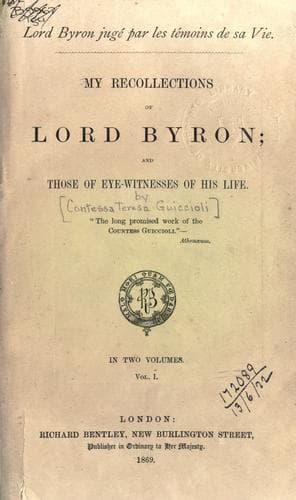
My Recollections of Lord ByronGuiccioli, Teresa, contessa di
General
My Recollections of Lord Byron
Guiccioli, Teresa, contessa di
Byron, George Gordon Byron, Baron, 1788-1824; Poets, English -- 19th century -- Biography
He belonged to the Gallic race (modified by the Latin and Celtic
elements) by his vivacity and mobility of character, as well as by his
wit and his keen appreciation of the ridiculous, by those smiles and
sarcasms which hide or discover a profound philosophy, by his perception
of humor without malice, by all those amiable qualities which in the
daily intercourse of life made of him a being of such irresistible
attraction. He belonged to that race likewise by his great
sensitiveness, by his expansive good-nature, by his politeness, by his
tractableness, by his universal character which rendered every species
of success easy to him; by his great generosity, by his love of glory,
by his passion for honor, his intuitive perception of great deeds, by a
courage which might have appeared rash, had it not been heroic, and
which, in presence of the greatest perils and even of death, ever
preserved for him that serenity of mind which allowed him to laugh, even
at such times; by his energy, and also by his numerous mental and bodily
requirements; and by his defects,--which were, a slight tendency to
indiscretion, a want of prudence injurious to his interests,
impatience, and a kind of intermittent and apparent fickleness.
He belonged to the western race by his vast intellect, by his practical
common sense, which formed the basis of his intellect, and which never
allowed him to divorce sublime conceptions from sound sense and good
reason,--two qualities, in fact, which so governed his imagination as to
make people say he had not any; by the depth of his feelings, the extent
of his learning, his passion for independence, his contempt of death,
his thirst for the infinite, and by that kind of melancholy which seemed
to follow him into the midst of every pleasure. All these various
elements, which belonged separately to individuals in France, in
England, and in various countries, being united in Lord Byron, produced
a kind of anomaly which startled systematic critics, and even honest
biographers. The apparent contradiction of all these qualities caused
his critics to lose their psychological compass in their estimate of his
charming nature, and justice, together with truth, suffered by the
result. Thus a portrait, drawn over and over again, still remains to be
painted.
The most imaginary portrait, however, of Lord Byron, and certainly the
least like him, is that which has general currency in France: not only
has that portrait not been drawn from nature, not only is it a
caricature, but it is also a calumny. Those who drew it took romance for
history. They charged or exaggerated incidents in his life and
peculiarities of his character; thus the harmony of the _tout ensemble_
was lost. Ugliness and eccentricity, which amuse, succeeded beauty and
truth, which are sometimes wearisome.
Public-domain text, read in full here on John Shaqi.
Reviews
Reviews
No reviews yet
Be the first to share your thoughts on this work.
Elsewhere in the archive
Join the Discussion
Join the discussion
Sign in to leave a comment or review.
Sign InorCreate an account