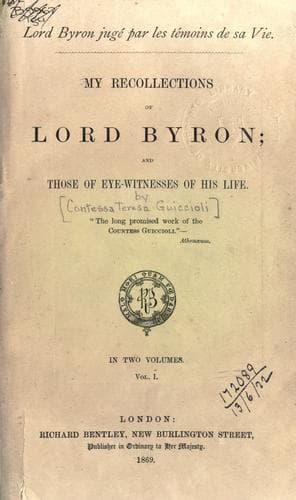
My Recollections of Lord ByronGuiccioli, Teresa, contessa di
General
My Recollections of Lord Byron
Guiccioli, Teresa, contessa di
Byron, George Gordon Byron, Baron, 1788-1824; Poets, English -- 19th century -- Biography
It might almost be said that he was quite the opposite of what a Saxon
should be. Lord Byron could not remain, and, actually, lived a very
short time, in England. His habits were not English, nor his mode of
living. Far from over-eating, as the English, according to M. Taine, are
said to do, Byron did not eat enough. He was as sober as a monk. His
favorite food was vegetables. His abstinence from meat dated from his
youth. His body was little adapted to the material wants of his country.
This remarkable sobriety was the effect of taste and principle, and was
in no ways broken by excesses which might have acted as compensations.
The excesses of which M. Taine speaks must have been at the utmost some
slight deviations from the real Pythagorean abstinence which he had laid
down as the rule of his life. Abroad, where he lived almost all his
life, he had none of the habits of his countrymen. He lived everywhere
as a cosmopolitan. All that his body craved for was cleanliness, and
this only served to improve his health and the marvellous beauty with
which God had gifted him.
Lord Byron was so little partial to the characteristic features and
customs of the country in which he was born--"but where he would not
die"--that the then so susceptible _amour-propre_ of his countrymen
reproached him with it as a most unpardonable fault.
It was not he who would have placed England and the English above all
foreigners, and Frenchmen in particular; nor was it he who would have
declared them to be the princes of the human race. Justice and truth
forbade his committing himself to such statements in the name of
national pride.
Are the animal rather than moral, and moral rather than intellectual
instincts of energy and will, which M. Taine so much admires in the
Saxon race, defects or qualities in his eyes? It is difficult to say,
for one never knows when he is praising or when he is condemning.
Judging by the very material causes from which he derives this
energy,--namely, the constitution of the people, their climate, their
frequent craving for food, their way of cooking the food they eat, their
drinks, and all the consequences of these necessities visible in the
absence of all sense of delicacy, of all appreciation of the fine arts,
and the comprehension of philosophy,--he must evidently intend to
depreciate them.
But as regards Lord Byron in particular, it is equally certain that he
has no intention of depreciating him. For him alone he finds expressions
of great admiration and real sympathy. He allows him to represent the
whole nation, and to be the incarnation of the English character; but on
one condition,--that of ruling it as its sovereign. Thanks to this
supremacy, the poet escapes more or less the exigencies of M. Taine's
theories.
Public-domain text, read in full here on John Shaqi.
Reviews
Reviews
No reviews yet
Be the first to share your thoughts on this work.
Elsewhere in the archive
Join the Discussion
Join the discussion
Sign in to leave a comment or review.
Sign InorCreate an account