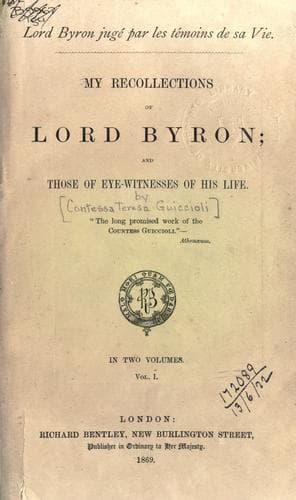
My Recollections of Lord ByronGuiccioli, Teresa, contessa di
General
My Recollections of Lord Byron
Guiccioli, Teresa, contessa di
Byron, George Gordon Byron, Baron, 1788-1824; Poets, English -- 19th century -- Biography
The reader will judge whether I shall be able to accomplish this object;
he will see how really unimportant are the causes which cast a shade
upon the memory of Byron, and how careful one should be not to give
credit too implicitly to the sincerity of that hypocritical praise which
several of his biographers have bestowed upon him. They have, as it
were, generally, taken a kind of pleasure in dwelling upon his age, his
rank, and other extenuating circumstances, as a cover to their censure,
just as if Byron ever required their forgiveness. In thus searching into
the secrets of his heart, and analyzing his life, the reader will soon
be obliged to admit, that if Byron, in common with others, had a few of
the faults of youth, he in return had a host of virtues which belonged
only to him. In short, if Byron is received in the light in which he was
esteemed by those who knew him personally, he will still constitute one
of the finest, most amiable, and grandest characters of his century. As
for ourselves, in summing up the merits of this very humble, but very
conscientious work, we can only repeat with delight the beautiful words
in which Moore sums up his own estimate of Lord Byron's worth: "Should
the effect of my humble labors be to clear away some of those mists that
hung round my friend, and show him, in most respects, as worthy of love
as he was, in all, of admiration, then will the chief and sole aim of
this work have been accomplished."[16]
FOOTNOTES:
[Footnote 10: When political events obliged Count Gamba to quit Romagna,
he thought at first of going with his family to take up his abode at
Geneva.
Lord Byron, on learning this, through a letter from the Countess
Guiccioli, who had rejoined her family at Florence, disapproved of their
design, and begged Shelley--then on a visit to him at Ravenna--to
express for him his disapprobation, and state the reasons of it. Shelley
addressed the following letter in Italian to the countess, and the
project was abandoned:--
"MADAM,--At the request of my friend, Lord Byron, I consider it my duty
to offer you some considerations relative to the proposed journey to
Geneva, so as to give you an idea of the undesirable results likely to
follow. I flatter myself that you will accept this request of his,
together with the motives leading me to acquiesce, as an excuse for the
liberty taken by a total stranger. In acting thus, the sole object I
have in view is my friend's peace of mind, and that of those in whom he
is so deeply interested. I have no other motive, nor can entertain any
other; and let it suffice, in proof of my perfect sincerity, to assure
you that I also have suffered from an intolerant clergy at home, and
from tyranny, and that I like your family, have met with persecution and
calumny as my sole reward for love of country.
Public-domain text, read in full here on John Shaqi.
Reviews
Reviews
No reviews yet
Be the first to share your thoughts on this work.
Elsewhere in the archive
Join the Discussion
Join the discussion
Sign in to leave a comment or review.
Sign InorCreate an account