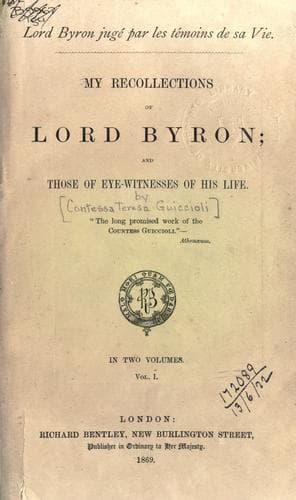
My Recollections of Lord ByronGuiccioli, Teresa, contessa di
General
My Recollections of Lord Byron
Guiccioli, Teresa, contessa di
Byron, George Gordon Byron, Baron, 1788-1824; Poets, English -- 19th century -- Biography
[Footnote 13: Madame de Stael said one day at Coppet, with an air of
mystery, "You are often seen at night, Lord Byron, in your bark upon the
lake, accompanied by a white phantom." "Yes," answered he, "'tis my
dog." Madame de Stael shook her head, not at all convinced that he kept
such innocent company, for her head had been filled with fantastic tales
and lies about him. In this instance, however, she was somewhat right;
for the white phantom was not only his dog, but often Mrs. Shelley, and
even sometimes a young woman intimate with her. This lady, with whom he
had, and would have, nothing to do, was bent on running after him,
although he did all in his power to avoid her. She succeeded sometimes
in getting into the boat with the Shelleys, and thus made inquisitive
people talk. But Lord Byron was very innocent in it all, and even
victimized, for the _ennui_ it caused him made him quit Switzerland and
the Alps, he loved so well, before the season was even over.]
[Footnote 14: "Essai sur Lord Byron," p. 177.]
[Footnote 15: Lord Byron wrote to Moore in November, 1820:--
"Pray, where did you get hold of Goethe's 'Florentine' husband-killing
story? Upon such matters, in general, I may say, with Beau Clinker, in
reply to Erraud's wife:--
"'Oh, the villain, he hath murdered my poor Timothy!'
"_Clinker._--'Damn your Timothy! I tell you, woman, your husband has
murdered me--he has carried away my fine jubilee clothes.'"]
[Footnote 16: Moore, vol. ii. p. 782]
CHAPTER IV.
LORD BYRON'S RELIGIOUS OPINIONS.
"When the triumph of a cause of such importance to humanity is in
question, there never can be too many advocates.... But it is not
enough to count up the votes; their value must, above all, be
weighed."--SHERER.
The struggles between heart and reason, in religious matters, began
almost with Lord Byron's infancy. His desire of reconciling them was
such, that, if unsuccessful, his mind was perplexed and restless. He was
not, as it were, out of the cradle, when, in the midst of his childish
play, the great problems of life already filled his youthful thoughts;
and his good nurse May, who was wont to sing psalms to him when rocking
him to sleep, had also to answer questions which showed the dangerous
curiosity of his mind.
"Among the traits," says Moore, "which should be recorded of his earlier
years, I should mention, that, according to the character given of him
by his first nurse's husband, he was, when a mere child, 'particularly
inquisitive and puzzling about religion.'"
Public-domain text, read in full here on John Shaqi.
Reviews
Reviews
No reviews yet
Be the first to share your thoughts on this work.
Elsewhere in the archive
Join the Discussion
Join the discussion
Sign in to leave a comment or review.
Sign InorCreate an account