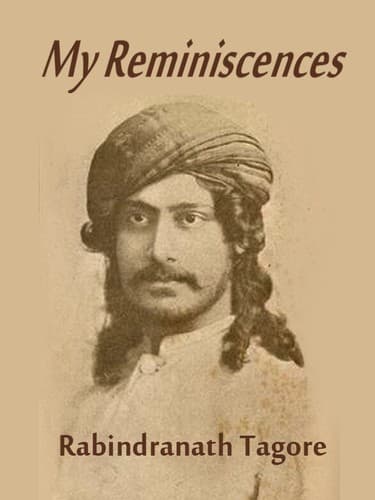
Authors, Bengali -- 20th century -- Biography; Tagore, Rabindranath, 1861-1941
I spent some months here. Then it was time for my brother to return
home, and my father wrote to me to accompany him. I was delighted at the
prospect. The light of my country, the sky of my country, had been
silently calling me. When I said good bye Mrs. Scott took me by the hand
and wept. "Why did you come to us," she said, "if you must go so soon?"
That household no longer exists in London. Some of the members of the
Doctor's family have departed to the other world, others are scattered
in places unknown to me. But it will always live in my memory.
One winter's day, as I was passing through a street in Tunbridge Wells,
I saw a man standing on the road side. His bare toes were showing
through his gaping boots, his breast was partly uncovered. He said
nothing to me, perhaps because begging was forbidden, but he looked up
at my face just for a moment. The coin I gave him was perhaps more
valuable than he expected, for, after I had gone on a bit, he came after
me and said: "Sir, you have given me a gold piece by mistake," with
which he offered to return it to me. I might not have particularly
remembered this, but for a similar thing which happened on another
occasion. When I first reached the Torquay railway station a porter took
my luggage to the cab outside. After searching my purse for small change
in vain, I gave him half-a-crown as the cab started. After a while he
came running after us, shouting to the cabman to stop. I thought to
myself that finding me to be such an innocent he had hit upon some
excuse for demanding more. As the cab stopped he said: "You must have
mistaken a half-crown piece for a penny, Sir!"
I cannot say that I have never been cheated while in England, but not in
any way which it would be fair to hold in remembrance. What grew chiefly
upon me, rather, was the conviction that only those who are trustworthy
know how to trust. I was an unknown foreigner, and could have easily
evaded payment with impunity, yet no London shopkeeper ever mistrusted
me.
During the whole period of my stay in England I was mixed up in a
farcical comedy which I had to play out from start to finish. I happened
to get acquainted with the widow of some departed high Anglo-Indian
official. She was good enough to call me by the pet-name Ruby. Some
Indian friend of hers had composed a doleful poem in English in memory
of her husband. It is needless to expatiate on its poetic merit or
felicity of diction. As my ill-luck would have it, the composer had
indicated that the dirge was to be chanted to the mode _Behaga_. So the
widow one day entreated me to sing it to her thus. Like the silly
innocent that I was, I weakly acceded. There was unfortunately no one
there but I who could realise the atrociously ludicrous way in which the
_Behaga_ mode combined with those absurd verses. The widow seemed
intensely touched to hear the Indian's lament for her husband sung to
its native melody. I thought that there the matter ended, but that was
not to be.
Public-domain text, read in full here on John Shaqi.
Reviews
Reviews
No reviews yet
Be the first to share your thoughts on this work.
Elsewhere in the archive
Join the Discussion
Join the discussion
Sign in to leave a comment or review.
Sign InorCreate an account