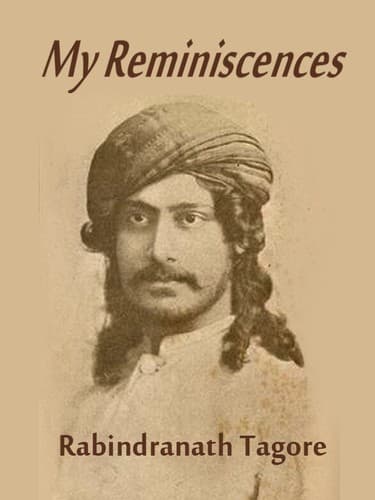
Authors, Bengali -- 20th century -- Biography; Tagore, Rabindranath, 1861-1941
But one thing I refuse to admit. Behind this charge of vagueness was the
sting of the insinuation of its being a deliberate affectation--for the
sake of effect. The fortunate possessor of good eye-sight is apt to
sneer at the youth with glasses, as if he wears them for ornament. While
a reflection on the poor fellow's infirmity may be permissible, it is
too bad to charge him with pretending not to see.
The nebula is not an outside creation--it merely represents a phase; and
to leave out all poetry which has not attained definiteness would not
bring us to the truth of literature. If any phase of man's nature has
found true expression, it is worth preserving--it may be cast aside only
if not expressed truly. There is a period in man's life when his
feelings are the pathos of the inexpressible, the anguish of vagueness.
The poetry which attempts its expression cannot be called baseless--at
worst it may be worthless; but it is not necessarily even that. The sin
is not in the thing expressed, but in the failure to express it.
There is a duality in man. Of the inner person, behind the outward
current of thoughts, feelings and events, but little is known or recked;
but for all that, he cannot be got rid of as a factor in life's
progress. When the outward life fails to harmonise with the inner, the
dweller within is hurt, and his pain manifests itself in the outer
consciousness in a manner to which it is difficult to give a name, or
even to describe, and of which the cry is more akin to an inarticulate
wail than words with more precise meaning.
The sadness and pain which sought expression in the _Evening Songs_ had
their roots in the depths of my being. As one's sleep-smothered
consciousness wrestles with a nightmare in its efforts to awake, so the
submerged inner self struggles to free itself from its complexities and
come out into the open. These _Songs_ are the history of that struggle.
As in all creation, so in poetry, there is the opposition of forces. If
the divergence is too wide, or the unison too close, there is, it seems
to me, no room for poetry. Where the pain of discord strives to attain
and express its resolution into harmony, there does poetry break forth
into music, as breath through a flute.
When the _Evening Songs_ first saw the light they were not hailed with
any flourish of trumpets, but none the less they did not lack admirers.
I have elsewhere told the story of how at the wedding of Mr. Ramesh
Chandra Dutt's eldest daughter, Bankim Babu was at the door, and the
host was welcoming him with the customary garland of flowers. As I came
up Bankim Babu eagerly took the garland and placing it round my neck
said: "The wreath to him, Ramesh, have you not read his _Evening
Songs_?" And when Mr. Dutt avowed he had not yet done so, the manner in
which Bankim Babu expressed his opinion of some of them amply rewarded
me.
Public-domain text, read in full here on John Shaqi.
Reviews
Reviews
No reviews yet
Be the first to share your thoughts on this work.
Elsewhere in the archive
Join the Discussion
Join the discussion
Sign in to leave a comment or review.
Sign InorCreate an account