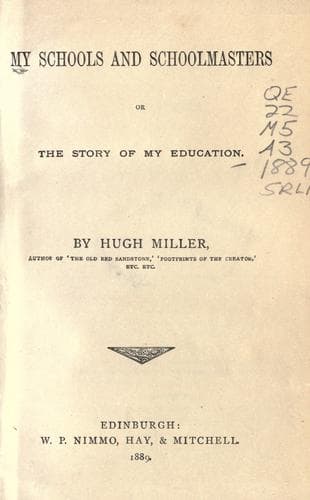
My Schools and Schoolmasters; Or, The Story of My EducationMiller, Hugh
Philosophy
My Schools and Schoolmasters; Or, The Story of My Education
Miller, Hugh
Education -- Scotland -- History -- 19th century; Geologists -- Scotland -- Biography; Miller, Hugh, 1802-1856 -- Knowledge and learning
But what most impressed the
narrator--for it must have been a frightful incident in a sad
spectacle--was the circumstance that, when the charred remains of the
victim were sputtering and boiling amid the intense heat of the flames,
a cross gust of wind suddenly blew the smoke athwart the spectators, and
she felt in her attendant's arms as if in danger of being suffocated by
the horrible stench. I have heard described, too, by a man whose father
had witnessed the scene, an execution which took place, after a brief
and inadequate trial, on the burgh-gallows of Tain. The supposed
culprit, a Strathcarron Highlander, had been found lurking about the
place, noting, as was supposed, where the burghers kept their cattle,
and was hung as a spy; but they all, after the execution, came to deem
him innocent, from the circumstance that, when his dead body was
dangling in the wind, a white pigeon had come flying the way, and, as it
passed over, half-encircled the gibbet.
One of the two Culloden soldiers whom I remember was an old forester who
lived in a picturesque cottage among the woods of the Cromarty Hill; and
in his last illness, my uncles, whom I had always leave to accompany,
used not unfrequently to visit him. He had lived at the time his full
century, and a few months more: and I still vividly remember the large
gaunt face that used to stare from the bed as they entered, and the
huge, horny hand. He had been settled in life, previous to the year
1745, as the head gardener of a northern proprietor, and little dreamed
of being engaged in war; but the rebellion broke out; and as his master,
a stanch Whig, had volunteered to serve on behalf of his principles in
the royal army, his gardener, a "mighty man of his hands," went with
him. As his memory for the later events of his life was gone at this
time, its preceding forty years seemed a blank, from which not a single
recollection could be drawn; but well did he remember the battle, and
more vividly still, the succeeding atrocities of the troops of
Cumberland. He had accompanied the army, after its victory at Culloden,
to the camp at Fort-Augustus, and there witnessed scenes of cruelty and
spoliation of which the recollection, after the lapse of seventy years,
and in his extreme old age, had still power enough to set his Scotch
blood aboil. While scores of cottages were flaming in the distance, and
blood not unfrequently hissing on the embers, the men and women of the
army used to be engaged in racing in sacks, or upon Highland ponies; and
when the ponies were in request, the women, who must have sat for their
portraits in Hogarth's "March to Finchley," took their seats astride
like the men. Gold circulated and liquor flowed in abundance; and in a
few weeks there were about twenty thousand head of cattle brought in by
marauding parties of the soldiery from the crushed and impoverished
Highlanders; and groups of drovers from Yorkshire and the south of
Public-domain text, read in full here on John Shaqi.
Reviews
Reviews
No reviews yet
Be the first to share your thoughts on this work.
Elsewhere in the archive
Join the Discussion
Join the discussion
Sign in to leave a comment or review.
Sign InorCreate an account