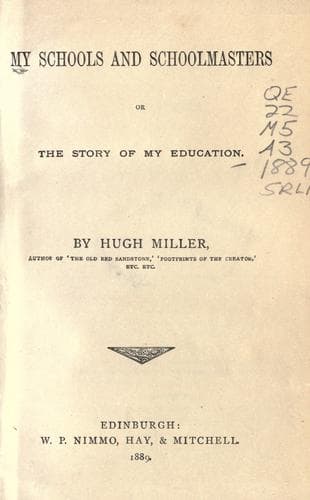
My Schools and Schoolmasters; Or, The Story of My EducationMiller, Hugh
Philosophy
My Schools and Schoolmasters; Or, The Story of My Education
Miller, Hugh
Education -- Scotland -- History -- 19th century; Geologists -- Scotland -- Biography; Miller, Hugh, 1802-1856 -- Knowledge and learning
it was my privilege to be placed; and though the state could have been
no very favourable one for forming a resolution, I in that hour
determined that I should never again sacrifice my capacity of
intellectual enjoyment to a drinking usage; and, with God's help, I was
enabled to hold by the determination. Though never a strict abstainer, I
have wrought as an operative mason for whole twelvemonths together, in
which I did not consume half-a-dozen glasses of ardent spirits, or
partake of half-a-dozen draughts of fermented liquor. But I do see, in
looking back on this my first year of labour, a dangerous point, at
which, in the attempt to escape from the sense of depression and
fatigue, the craving appetite of the confirmed tippler might have been
formed.
The ordinary, long-wrought quarries of my native town have been opened
in the old coast-line along the southern shores of the Cromarty Firth,
and they contain no organisms. The beds occasionally display their
water-rippled surfaces, and occasionally their areas of ancient
desiccation, in which the polygonal partings still remain as when they
had cracked in the drying, untold ages before. But the rock contains
neither fish nor shell; and the mere mechanical processes of which it
gave evidence, though they served to raise strange questions in my mind,
failed to interest me so deeply as the wonderful organisms of other
creations would have done. We soon quitted these quarries, however, as
they proved more than usually difficult in the working at this time, for
a quarry situated on the northern shore of the Moray Firth, which had
been recently opened in an inferior member of the Lower Old Red
Sandstone, and which, as I subsequently ascertained, does in some of its
beds contain fossils. It was, however, not to the quarry itself that my
first-found organisms belonged. There lies in the Firth beyond, an
outlier of the Lias, which, like the Marcus' Cave one referred to in a
preceding chapter, strews the beach with its fragments after every storm
from the sea; and in a nodular mass of bluish-grey limestone derived
from this subaqueous bed I laid open my first-found ammonite. It was a
beautiful specimen, graceful in its curves as those of the Ionic volute,
and greatly more delicate in its sculpturing; and its bright
cream-coloured tint, dimly burnished by the prismatic hues of the
original pearl, contrasted exquisitely with the dark grey of the matrix
which enclosed it. I broke open many a similar nodule during our stay at
this delightful quarry, and there were few of them in which I did not
detect some organism of the ancient world--scales of fishes, groups of
shells, bits of decayed wood, and fragments of fern. At the dinner hour
I used to show my new-found specimens to the workmen; but though they
always took the trouble of looking at them, and wondered at times how
the shells and plants had "got into the stones," they seemed to regard
Public-domain text, read in full here on John Shaqi.
Reviews
Reviews
No reviews yet
Be the first to share your thoughts on this work.
Elsewhere in the archive
Join the Discussion
Join the discussion
Sign in to leave a comment or review.
Sign InorCreate an account