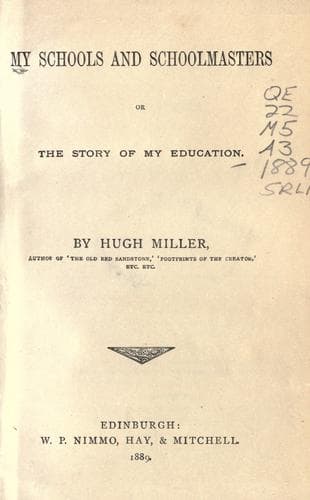
My Schools and Schoolmasters; Or, The Story of My EducationMiller, Hugh
Philosophy
My Schools and Schoolmasters; Or, The Story of My Education
Miller, Hugh
Education -- Scotland -- History -- 19th century; Geologists -- Scotland -- Biography; Miller, Hugh, 1802-1856 -- Knowledge and learning
however, not much accustomed at the time to so rough a bed: every time I
turned me in my lair, the strong, stiff straw rustled against my face;
and about midnight I awoke.
I rose to a little window which opened upon a dreary moor, and commanded
a view in the distance, of a ruinous chapel and solitary burying-ground,
famous in the traditions of the district as the chapel and
burying-ground of Gillie-christ. Dr. Johnson relates, in his "Journey,"
that when eating, on one occasion, his dinner in Skye to the music of
the bagpipe, he was informed by a gentleman, "that in some remote time,
the Macdonalds of Glengarry having been injured or offended by the
inhabitants of Culloden, and resolving to have justice, or vengeance,
they came to Culloden on a Sunday, when, finding their enemies at
worship, they shut them up in the church, which they set on fire; and
this, said he, is the tune that the piper played while they were
burning." Culloden, however, was not the scene of the atrocity: it was
the Mackenzies of Ord that their fellow-Christians and
brother-Churchmen, the Macdonalds of Glengarry, succeeded in converting
into animal charcoal, when the poor people were engaged, like good
Catholics, in attending mass; and in this old chapel of Gillie-christ
was the experiment performed. The Macdonalds, after setting fire to the
building, held fast the doors until the last of the Mackenzies of Ord
had perished in the flames; and then, pursued by the Mackenzies of
Brahan, they fled into their own country, to glory ever after in the
greatness of the feat. The evening was calm and still, but dark for the
season, for it was now near mid-summer; and every object had disappeared
in the gloom, save the outlines of a ridge of low hills that rose beyond
the moor; but I could determine where the chapel and churchyard lay; and
great was my astonishment to see a light flickering amid the
grave-stones and the ruins. At one time seen, at another hid, like the
revolving lantern of a lighthouse, it seemed to be passing round and
round the building; and, as I listened, I could hear distinctly what
appeared to be a continuous screaming of most unearthly sound,
proceeding from evidently the same spot as the twinkle of the light.
What could be the meaning of such an apparition, with such
accompaniments--the time of its appearance midnight--the place a
solitary burying-ground? I was in the Highlands: was there truth, after
all, in the many floating Highland stories of spectral dead-lights and
wild supernatural sounds, seen and heard by nights in lonely places of
sepulture, when some sudden death was near? I did feel my blood run
somewhat cold, for I had not yet passed the credulous time of life--and
had some thoughts of stealing down to my master's bedside, to be within
reach of the human voice, when I saw the light quitting the churchyard,
and coming downwards across the moor in a straight line, though tossed
about in the dead calm, in many a wave and flourish; and further, I
Public-domain text, read in full here on John Shaqi.
Reviews
Reviews
No reviews yet
Be the first to share your thoughts on this work.
Elsewhere in the archive
Join the Discussion
Join the discussion
Sign in to leave a comment or review.
Sign InorCreate an account