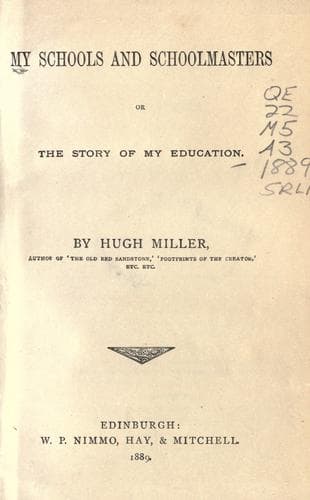
My Schools and Schoolmasters; Or, The Story of My EducationMiller, Hugh
Philosophy
My Schools and Schoolmasters; Or, The Story of My Education
Miller, Hugh
Education -- Scotland -- History -- 19th century; Geologists -- Scotland -- Biography; Miller, Hugh, 1802-1856 -- Knowledge and learning
The specific peculiarities induced by particular professions are not
less marked than the generic ones. How different, for instance, the
character of a sedentary tailor, as such, from that of the equally
sedentary barber! Two imperfectly-taught young lads, of not more than
the average intellect, are apprenticed, the one to the hair-dresser, the
other to the fashionable clothes-maker of a large village. The barber
has to entertain his familiar round of customers, when operating upon
their heads and beards. He must have no controversies with them; that
might be disagreeable, and might affect his command of the scissors or
razor; but he is expected to communicate to them all he knows of the
gossip of the place; and as each customer supplies him with a little, he
of course comes to know more than anybody else. And as his light and
easy work lays no stress on his respiration, in course of time he learns
to be a fast and fluent talker, with a great appetite for news, but
little given to dispute. He acquires, too, if his round of customers be
good, a courteous manner; and if they be in large proportion
Conservatives, he becomes, in all probability, a Conservative too. The
young tailor goes through an entirely different process. He learns to
regard dress as the most important of all earthly things--becomes
knowing in cuts and fashions--is taught to appreciate, in a way no other
individual can, the aspect of a button, or the pattern of a vest; and as
his work is cleanly, and does not soil his clothes, and as he can get
them more cheaply, and more perfectly in the fashion, than other
mechanics, the chances are ten to one that he turns out a beau. He
becomes great in that which he regards as of all things greatest--dress.
A young tailor may be known by the cut of his coat and the merits of his
pantaloons, among all other workmen; and as even fine clothes are not
enough of themselves, it is necessary that he should also have fine
manners; and not having such advantages of seeing polite society as his
neighbour the barber, his gentlemanly manners are always less fine than
grotesque. Hence more ridicule of tailors among working men than of any
other class of mechanics. And such--if nature has sent them from her
hand ordinary men, for the extraordinary rise above all the modifying
influences of profession--are the processes through which tailors and
hair-dressers put on then distinctive characters as such. A village
smith hears well-nigh as much gossip as a village barber; but he
develops into an entirely different sort of man. He is not bound to
please his customers by his talk; nor does his profession leave his
breath free enough to talk fluently or much; and so he listens in grim
and swarthy independence--strikes his iron while it is hot--and when,
after thrusting it into the fire, he bends himself to the bellows, he
drops, in rude phrase, a brief judicial remark, and again falls sturdily
to work.
Public-domain text, read in full here on John Shaqi.
Reviews
Reviews
No reviews yet
Be the first to share your thoughts on this work.
Elsewhere in the archive
Join the Discussion
Join the discussion
Sign in to leave a comment or review.
Sign InorCreate an account