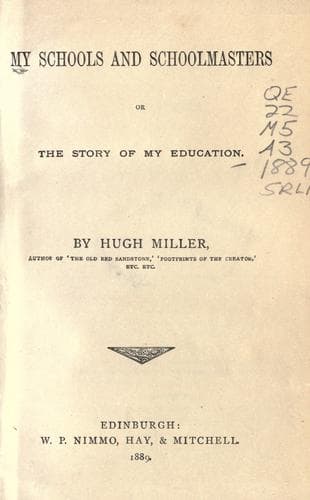
My Schools and Schoolmasters; Or, The Story of My EducationMiller, Hugh
Philosophy
My Schools and Schoolmasters; Or, The Story of My Education
Miller, Hugh
Education -- Scotland -- History -- 19th century; Geologists -- Scotland -- Biography; Miller, Hugh, 1802-1856 -- Knowledge and learning
stand, it imparted by its solid reality a degree of authenticity to the
story in this part of the country, which, if unfurnished with a "local
habitation," as in Sir Walter's note, it would have wanted. Such was one
of the many stories of the Conon with which I became acquainted at a
time when the beliefs they exemplified were by no means quite dead, and
of which I could think as tolerably serious realities, when, lying a-bed
all alone at midnight, the solitary inmate of a dreary barrack,
listening to the roar of the Conon.
Besides the long evenings, we had an hour to breakfast, and another to
dinner. Much of the breakfast hour was spent in cooking our food; but as
a bit of oaten cake and a draught of milk usually served us for the
mid-day meal, the greater part of the hour assigned to _it_ was
available for purposes of rest or amusement. And when the day was fine,
I used to spend it by the side of a mossy stream, within a few minutes'
walk of the work-shed, or in a neighbouring planting, beside a little
irregular lochan, fringed round with flags and rushes. The mossy stream,
black in its deeper pools, as if it were a rivulet of tar, contained a
good many trout, which had acquired a hue nearly as deep as its own, and
formed the very negroes of their race. They were usually of small
size--for the stream itself was small; and, though little countries
sometimes produce great men, little streams rarely produce great fish.
But on one occasion, towards the close of autumn, when a party of the
younger workmen set themselves, in a frolic, to sweep it with torch and
spear, they succeeded in capturing, in a dark alder-o'ershaded pool, a
monstrous individual, nearly three feet in length, and proportionally
bulky, with a snout bent over the lower jaw at its symphysis, like the
beak of a hawk, and as deeply tinged (though with more of brown in its
complexion) as the blackest coal-fish I ever saw. It must have been a
bull-trout, a visitor from the neighbouring river; but we all concluded
at the time, from the extreme dinginess of its coat, that it had lived
for years in its dark pool, a hermit apart from its fellows. I am not
now, however, altogether certain that the inference was a sound one.
Some fishes, like some men, have a wonderful ability of assuming the
colours that best suit their interests for the time. I have been unable
to determine whether the trout be one of these conformists; but it used
to strike me at this period as at least curious, that the fishes in even
the lower reaches of the dark little rivulet should differ so entirely
in hue from those of the greatly clearer Conon, into which its peaty
waters fall, and whose scaly denizens are of silvery brightness. No fish
seems to possess a more complete power over its dingy coat than a very
abundant one in the estuary of the Conon--the common flounder. Standing
on the bank, I have startled these creatures from off the patch of
Public-domain text, read in full here on John Shaqi.
Reviews
Reviews
No reviews yet
Be the first to share your thoughts on this work.
Elsewhere in the archive
Join the Discussion
Join the discussion
Sign in to leave a comment or review.
Sign InorCreate an account