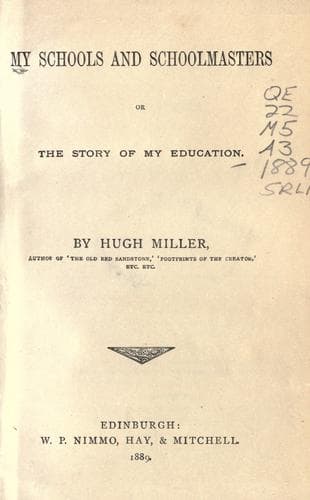
My Schools and Schoolmasters; Or, The Story of My EducationMiller, Hugh
Philosophy
My Schools and Schoolmasters; Or, The Story of My Education
Miller, Hugh
Education -- Scotland -- History -- 19th century; Geologists -- Scotland -- Biography; Miller, Hugh, 1802-1856 -- Knowledge and learning
the beautiful winged creature that sprang out of the pupa into which the
repulsive-looking pirate had been transformed, launch forth into its new
element, changed in everything save its nature, but still unchanged in
that, and rendering itself as formidable to the moth and the butterfly
as it had been before to the newt and the tadpole. There is, I daresay,
an analogy here also. It is in the first state of our own species, as
certainly as in that of the dragon-fly, that the character is fixed.
Further, I used to experience much interest in watching the progress of
the frog, in its earlier stages from the egg to the fish; then from the
fish to the reptile fish, with its fringed tail, and ventral and
pectoral _limbs_; and, last of all, from the reptile fish to the
complete reptile. I had not yet learned--nor was it anywhere known at
the time--that the history of the individual frog, through these
successive transformations, is a history in small of the animal creation
itself in its earlier stages--that in order of time the egg-like mollusc
had taken precedence of the fish, and the fish of the reptile; and that
an intermediate order of creatures had once abounded, in which, as in
the half-developed frog, the natures of both fish and reptile were
united. But, though unacquainted with this strange analogy, the
transformations were of themselves wonderful enough to fill for a time
my whole mind. I remember being struck one afternoon, after spending my
customary spare half hour beside the pond, and marking the peculiar
style of colouring in the yellow and black libellulidæ in the common
wasp, and in a yellow and black species of ichneumon fly, to detect in
some half-dozen gentlemen's carriages that were standing opposite our
work-shed--for the good old knight of Conon House had a dinner-party
that evening--exactly the same style of ornamental colouring. The
greater number of the vehicles were yellow and black--just as these were
the prevailing colours among the wasps and libellulidæ; but there was a
slight admixture of other colours among them too: there was at least one
that was black and green, or black and blue, I forget which; and another
black and brown. And so it was among the insects also: the same sort of
taste, both in colour and the arrangements of colour, and even in the
proportions of the various colours, seemed to have regulated the style
of ornament manifested in the carriages of the dinner party, and of the
insect visitors of the pond. Further, I thought I could detect a
considerable degree of resemblance in form between a chariot and an
insect. There was a great _abdominal_ body separated by a narrow isthmus
from a _thoracic_ coach-box, where the directing power was stationed;
while the wheels, poles, springs, and general framework on which the
vehicle rested, corresponded to the wings, limbs, and antennæ of the
insect. There was at least sufficient resemblance of form to justify
Public-domain text, read in full here on John Shaqi.
Reviews
Reviews
No reviews yet
Be the first to share your thoughts on this work.
Elsewhere in the archive
Join the Discussion
Join the discussion
Sign in to leave a comment or review.
Sign InorCreate an account