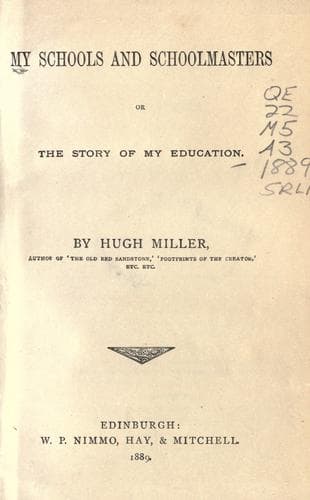
My Schools and Schoolmasters; Or, The Story of My EducationMiller, Hugh
Philosophy
My Schools and Schoolmasters; Or, The Story of My Education
Miller, Hugh
Education -- Scotland -- History -- 19th century; Geologists -- Scotland -- Biography; Miller, Hugh, 1802-1856 -- Knowledge and learning
I at once inferred that recovery awaited me: I was "to
live and not die;" and felt lighter, during the few weeks I afterwards
toiled at this place, under the cheering influence of the conviction.
The tenant of the farm on which our work was situated, and who had been
both a great distiller and considerable fanner in his day, had become
bankrupt shortly before, and was on the eve of quitting the place, a
broken man. And his forlorn circumstances seemed stamped on almost every
field and out-house of his farm. The stone fences were ruinous; the
hedges gapped by the almost untended cattle; a considerable sprinkling
of corn-ears lay rotting on the lea; and here and there an entire sheaf,
that had fallen from the "leading-cart" at the close of harvest, might
be seen still lying among the stubble, fastened to the earth by the
germination of its grains. Some of the out-houses were miserable beyond
description. There was a square of modern offices, in which the cattle
and horses of the farm--appropriated by the landlord, at the time under
the law of hypothec--were tolerably well lodged; but the hovel in which
three of the farm-servants lived, and in which, for want of a better, my
master and I had to cook and sleep, was one of the most miserable
tumble-down erections I ever saw inhabited. It had formed part of an
ancient set of offices that had been condemned about fourteen years
before; but the proprietor of the place becoming insolvent, it had been
spared, in lack of a better, to accommodate the servants who wrought on
the farm; and it had now become not only a comfortless, but also a very
unsafe dwelling. It would have formed no bad subject, with its bulging
walls and gapped roof, that showed the bare ribs through the breaches,
for the pencil of my friend William Koss; but the cow or horse that had
no better shelter than that which it afforded could not be regarded as
other than indifferently lodged. Every heavier shower found its way
through the roof in torrents: I could even tell the hour of the night by
the stars which passed over the long opening that ran along the ridge
from gable to gable; and in stormy evenings I have paused at every ruder
blast, in the expectation of hearing the rafters crack and give way over
my head. The distiller had introduced upon his farm, on a small scale,
what has since been extensively known as the bothy system; and this
hovel was the bothy. There were, as I have said, but three farm-servants
who lived in it at the time--young, unmarried lads, extremely ignorant,
and of gay, reckless dispositions, whose care for their master's
interests might be read in the germinating sheaves that lay upon his
fields, and who usually spoke of him, when out of his hearing, as "the
old sinner." He too evidently cared nothing for them; and they detested
him, and regarded the ruin which had overtaken him, and which their own
recklessness and indifference to his welfare must have at least assisted
to secure, with open satisfaction.
Public-domain text, read in full here on John Shaqi.
Reviews
Reviews
No reviews yet
Be the first to share your thoughts on this work.
Elsewhere in the archive
Join the Discussion
Join the discussion
Sign in to leave a comment or review.
Sign InorCreate an account