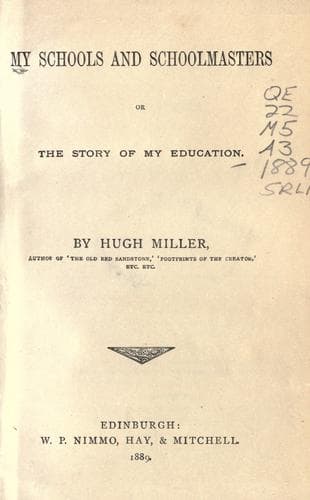
My Schools and Schoolmasters; Or, The Story of My EducationMiller, Hugh
Philosophy
My Schools and Schoolmasters; Or, The Story of My Education
Miller, Hugh
Education -- Scotland -- History -- 19th century; Geologists -- Scotland -- Biography; Miller, Hugh, 1802-1856 -- Knowledge and learning
read Ramsay's "Evergreen," the "King's Quair," and the true "Actes and
Deides of ye illuster and vailyeand campioun Shyr Wilham Wallace," not
modernized, as in my first copy, but in the tongue in which they had
been recited of old by Henry the Minstrel: I had previously gloated over
Harbour's Bruce; and thus my acquaintance with the old Scots poets, if
not very profound, became at least so respectable, that not until many
years after did I meet with an individual who knew them equally well.
The strange picturesque allegories of Douglas, and the terse sense and
racy humour of Dunbar, delighted me much. As I had to con my way slowly
amid the difficulties of a language which was no longer that spoken by
my country-folk, I felt as if I were creating the sense which I found;
it came gradually out like some fossil of the rock, from which I had
laboriously to chip away the enveloping matrix; and in hanging
admiringly over it, I thought I perceived how it was that some of my old
schoolfellows, who were prosecuting their education at college, were
always insisting on the great superiority of the old Greek and Roman
writers over the writers of our own country. I could not give them
credit for much critical discernment: they were indifferent enough, some
of them, to both verse and prose, and hardly knew in what poetry
consisted; and yet I believed them to be true to their perceptions when
they insisted on what they termed the high excellence of the ancients.
With my old schoolfellows, I now said, the process of perusal, when
reading an English work of classical standing, is so sudden, compared
with the slowness with which they imagine or understand, that they slide
over the surface of their author's numbers, or of his periods, without
acquiring a due sense of what lies beneath; whereas, in perusing the
works of a Greek or Latin author, they have just to do what I am doing
in deciphering the "Palice of Honour" or the "Goldin Terge,"--they have
to proceed slowly, and to render the language of their author into the
language of their own thinking. And so, losing scarce any of his meaning
in consequence, and not reflecting on the process through which they
have entered into it, they contrast the little which they gain from a
hurried perusal of a good English book, with the much which they gain
from the very leisurely perusal of a good Latin or Greek one; and term
_the little_ the poverty of modern writers, and _the much_ the fertility
of the ancients. Such was my theory, and it was at least not an
uncharitable one to my acquaintance. I was, however, arrested in the
middle of my studies by a day of soaking rain, which so saturated with
moisture the decayed spongy wood, our fuel, that, though I succeeded in
making with some difficulty such fires of it as sufficed to cook our
victuals, it defied my skill to make one by which I could read. At
length, however, this dreary season of labour--by far the gloomiest I
Public-domain text, read in full here on John Shaqi.
Reviews
Reviews
No reviews yet
Be the first to share your thoughts on this work.
Elsewhere in the archive
Join the Discussion
Join the discussion
Sign in to leave a comment or review.
Sign InorCreate an account