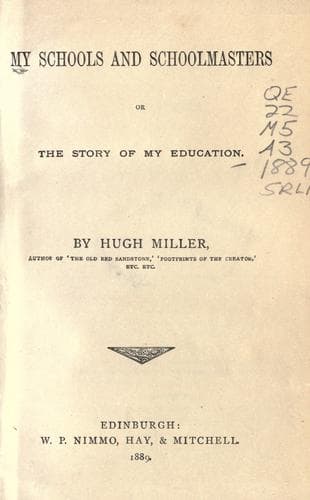
My Schools and Schoolmasters; Or, The Story of My EducationMiller, Hugh
Philosophy
My Schools and Schoolmasters; Or, The Story of My Education
Miller, Hugh
Education -- Scotland -- History -- 19th century; Geologists -- Scotland -- Biography; Miller, Hugh, 1802-1856 -- Knowledge and learning
saw, fast gaining on the sand; and it would be neither comfortable nor
safe to spread our dried grass and blankets over _it_. My comrade went
out to see whether the place did not furnish materials enough of any
kind to make a bedstead, and soon returned in triumph, dragging after
him a pair of harrows which he placed side by side in a snug corner
beside the fire, with of course the teeth downwards. A good Catholic,
prepared to win heaven for himself by a judicious use of sharp points,
might have preferred having them turned the other way; but my comrade
was an enlightened Protestant; and besides, like Goldsmith's sailor, he
loved to lie soft. The second piece of luck was mine. I found lying
unclaimed in the yard an old barn-door, which a recent gale had blown
from off its hinges; and by placing it above the harrows, and driving a
row of stakes around it into the floor, to keep the outer sleeper from
rolling off--for the wall served to secure the position of the inner
one--we succeeded in constructing, by our joint efforts, a luxurious
bed. There was but one serious drawback on its comforts: the roof
overhead was bad, and there was an obstinate drop, that used, during
every shower which fell in the season of sleep, to make a dead set at
my face, and try me at times with the water torture of the old story,
mayhap half a dozen times in the course of a single night.
Our barrack fairly fitted up, I set out with my comrade, whose knowledge
of Gaelic enabled him to act as my interpreter, to a neighbouring group
of cottages, to secure a labourer for the work of the morrow. The
evening was now beginning to darken; but there was still light enough to
show me that the little fields I passed through on my way resembled very
much those of Liliput, as described by Gulliver. They were, however,
though equally small, greatly more irregular, and had peculiarities,
too, altogether their own. The land had originally been stony; and as it
showed, according to the Highland phrase, its "bare bones through its
skin"--large bosses of the rock beneath coming here and there to the
surface--the Highlanders had gathered the stones in great pyramidal
heaps on the bare bosses; and so very numerous were these in some of the
fields, that they looked as if some malignant sorcerer had, in the time
of harvest, converted all their shocks into stone. On approaching the
cottage of our future labourer, I was attracted by a door of very
peculiar construction that lay against the wall. It had been brought
from the ancient pine forest on the western bank of Loch Maree, and was
formed of the roots of trees so curiously interlaced by nature, that
when cut out of the soil, which it had covered over like a piece of
network, it remained firmly together, and now formed a door which the
mere imitator of the rustic might in vain attempt to rival. We entered
the cottage, and plunging downwards two feet or so, found ourselves upon
Public-domain text, read in full here on John Shaqi.
Reviews
Reviews
No reviews yet
Be the first to share your thoughts on this work.
Elsewhere in the archive
Join the Discussion
Join the discussion
Sign in to leave a comment or review.
Sign InorCreate an account