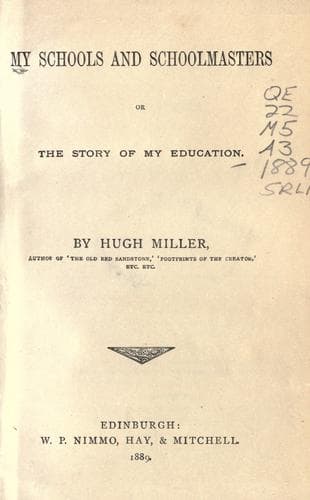
My Schools and Schoolmasters; Or, The Story of My EducationMiller, Hugh
Philosophy
My Schools and Schoolmasters; Or, The Story of My Education
Miller, Hugh
Education -- Scotland -- History -- 19th century; Geologists -- Scotland -- Biography; Miller, Hugh, 1802-1856 -- Knowledge and learning
Some of them were of a greatly more robust, and some of a
slimmer type, than others.
I was struck by another peculiarity in the west coast Highlanders. I
found the men in general greatly better-looking than the women, and that
in middle life they bore their years much more lightly. The females
seemed old and haggard at a period when the males were still
comparatively fresh and robust. I am not sure whether the remark may not
in some degree apply to Highlanders generally. The "rugged form" and
"harsher features," which, according to Sir Walter, "mark the mountain
band," accord worse with the female than with the male countenance and
figure. But I at least found this discrepancy in the appearance of the
sexes greatly more marked on the west than on the eastern coast; and saw
only too much reason to conclude that it was owing in great part to the
disproportionately large share of crushing labour laid, in the
district, in accordance with the practice of a barbarous time, on the
weaker frame of the female. There is, however, a style of female
loveliness occasionally though rarely exemplified in the Highlands,
which far transcends the Saxon or Scandinavian type. It is manifested
usually in extreme youth--at least between the fourteenth and eighteenth
year; and its effect we find happily indicated by Wordsworth--who seems
to have met with a characteristic specimen--in his lines to a Highland
girl. He describes her as possessing as her "dower," "a very _shower_ of
beauty." Further, however, he describes her as very young.
"Twice seven consenting years had shed
Their utmost bounty on her head."
I was, besides, struck at this time by finding, that while almost all
the young lads under twenty with whom I came in contact had at least a
smattering of English, I found only a single Highlander turned of forty
with whom I could exchange a word. The exceptional Highlander was,
however, a curiosity in his way. He seemed to have a natural turn for
acquiring languages, and had derived his English, not from conversation,
but, in the midst of a Gaelic-speaking people, from the study of the
Scriptures in our common English version. His application of Bible
language to ordinary subjects told at times with rather ludicrous
effect. Upon inquiring of him, on one occasion, regarding a young man
whom he wished to employ as an extra labourer, he described him in
exactly the words in which David is described in the chapter that
records the combat with Goliath, as "but a youth, and ruddy, and of a
fair countenance;" and on asking where he thought we could get a few
loads of water-rolled pebbles for causewaying a floor, he directed us to
the bed of a neighbouring rivulet, where we might "choose us," he said,
"smooth stones out of the brook." He spoke with great deliberation,
translating evidently his Gaelic thinking, as he went on, into
scriptural English.
CHAPTER XIII.
Public-domain text, read in full here on John Shaqi.
Reviews
Reviews
No reviews yet
Be the first to share your thoughts on this work.
Elsewhere in the archive
Join the Discussion
Join the discussion
Sign in to leave a comment or review.
Sign InorCreate an account