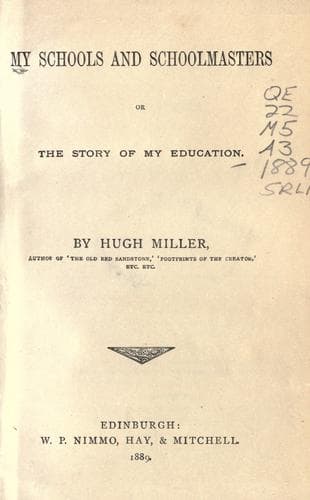
My Schools and Schoolmasters; Or, The Story of My EducationMiller, Hugh
Philosophy
My Schools and Schoolmasters; Or, The Story of My Education
Miller, Hugh
Education -- Scotland -- History -- 19th century; Geologists -- Scotland -- Biography; Miller, Hugh, 1802-1856 -- Knowledge and learning
occupied the central tract, rubble walls built in the ordinary style
leak like the bad roofs of other parts of the country; and
mansion-houses constructed within its precincts by qualified workmen
from Edinburgh and Glasgow have been found to admit the water in such
torrents as to be uninhabitable, until their more exposed walls had been
slated over like their roofs. Old John, however, always succeeded in
building water-tight walls. Departing from the ordinary rule of the
builder elsewhere, and which on the east coast of Scotland he himself
always respected, he slightly elevated the under beds of his stones,
instead of laying them, as usual, on the dead level; while along the
edges of their upper beds he struck off a small rude champer; and by
these simple contrivances, the rain, though driven with violence against
his work, coursed in streams along its face, without entering into the
interior and soaking through.
For about six weeks we had magnificent weather--clear, sunny skies, and
calm seas; and I greatly enjoyed my evening rambles amid the hills, or
along the sea-shore. I was struck, in these walks, by the amazing
abundance of the wild flowers which covered the natural meadows and
lower hill-slopes--an abundance, as I have since remarked, equally
characteristic of both the northern and western islands of Scotland. The
lower slopes of Gairloch, of western Sutherland, of Orkney, and of the
northern Hebrides generally--though, for the purposes of the
agriculturist, vegetation languishes, and wheat is never reared--are by
many degrees richer in wild flowers than the fat loamy meadows of
England. They resemble gaudy pieces of carpeting, as abundant in petals
as in leaves. Little of the rare is to be detected in these meadows,
save, perhaps, that in those of western Sutherland a few Alpine plants
may be found at a greatly lower level than elsewhere in Britain; but the
vast profusion of blossoms borne by species common to almost every other
part of the kingdom, imparts to them an apparently novel character. We
may detect, I am inclined to think, in this singular floral profusion,
the operation of a law not less influential in the animal than the
vegetable world, which, when hardship presses upon the life of the
individual shrub or quadruped, so as to threaten its vitality, renders
it fruitful on behalf of its species. I have seen the principle
strikingly exemplified in the common tobacco plant, when reared in a
northern country, in the open air. Year after year it continued to
degenerate, and to exhibit a smaller leaf and shorter stem, until the
successors of what in the first year of trial had been rigorous plants,
of some three to four feet in height, had in the sixth or eighth become
mere weeds, of scarce as many inches. But while the as yet undegenerate
plant had merely borne atop a few florets, which produced a small
quantity of exceedingly minute seeds, the stunted weed, its descendant,
Public-domain text, read in full here on John Shaqi.
Reviews
Reviews
No reviews yet
Be the first to share your thoughts on this work.
Elsewhere in the archive
Join the Discussion
Join the discussion
Sign in to leave a comment or review.
Sign InorCreate an account