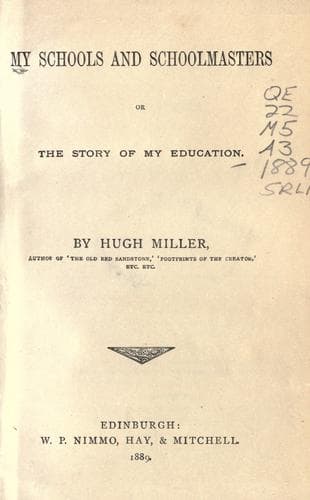
My Schools and Schoolmasters; Or, The Story of My EducationMiller, Hugh
Philosophy
My Schools and Schoolmasters; Or, The Story of My Education
Miller, Hugh
Education -- Scotland -- History -- 19th century; Geologists -- Scotland -- Biography; Miller, Hugh, 1802-1856 -- Knowledge and learning
At times my walks were directed along the sea-shore. Naturalists well
know how much the western coasts of Scotland differ in their productions
from its eastern ones; but it was a difference wholly new to me at this
time; and though my limited knowledge enabled me to detect it in but
comparatively few particulars, I found it no uninteresting task to trace
it for myself in even these few. I was first attracted by one of the
larger sea-weeds, _Himanthalia lorea_--with its cup-shaped disc and long
thong-like receptacles--which I found very abundant on the rocks here,
but which I had never seen in the upper reaches of the Moray Firth, and
which is by no means very common on any portion of the east coast. From
the sea-weeds I passed to the shells, among which I detected not only a
difference in the proportions in which the various species occurred, but
also species that were new to me--such as a shell, not rare in Gairloch,
_Nassa reticulata_, but rarely if ever seen in the Moray or Cromarty
Firths; and three other shells which I saw here for the first time,
_Trochus umbilicatus_, _Trochus magus_, and _Pecten niveus_.[5] I found,
too, that the common edible oyster, _ostrea edulis_, which on the east
coast lies always in comparatively deep water, is sometimes found in the
Gairloch, as, for instance, in the little bay opposite Flowerdale, in
beds laid bare by the ebb of stream-tides. It is always interesting to
come unexpectedly either upon a new species or a striking peculiarity in
an old one; and I deemed it a curious and suggestive fact that there
should be British shells still restricted to our western shores, and
that have not yet made their way into the German Ocean, along the coasts
of either extremity of the island. Are we to infer that they are shells
of more recent origin than the widely-diffused ones? or are they merely
feebler in their reproductive powers? and is the German Ocean, as some
of our geologists hold, a comparatively modern sea, into which only the
hardier mollusca of rapid increase have yet made their way? Further, I
found that the true fishes differ considerably in the group on the
opposite sides of the island. The haddock and whiting are greatly more
common on the east coast: the hake and horse mackerel very much more
abundant on the west. Even where the species are the same on both sides,
the varieties are different. The herring of the west coast is a short,
thick, richly-flavoured fish, greatly superior to the large lean variety
so abundant on the east; whereas the west-coast cod are large-headed,
thin-bodied, pale-coloured fishes, inferior, even in their best season,
to the darker-coloured, small-headed variety of the east. In no respect
do the two coasts differ more, or at least to the north of the
Grampians, than in the transparency of the water. The bottom is rarely
seen on the east coast at a depth of more than twenty feet, and not
often at more than twelve; whereas on the west I have seen it very
Public-domain text, read in full here on John Shaqi.
Reviews
Reviews
No reviews yet
Be the first to share your thoughts on this work.
Elsewhere in the archive
Join the Discussion
Join the discussion
Sign in to leave a comment or review.
Sign InorCreate an account