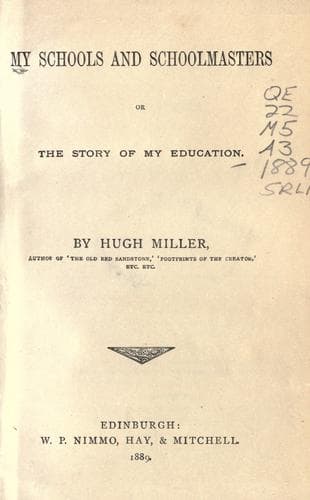
My Schools and Schoolmasters; Or, The Story of My EducationMiller, Hugh
Philosophy
My Schools and Schoolmasters; Or, The Story of My Education
Miller, Hugh
Education -- Scotland -- History -- 19th century; Geologists -- Scotland -- Biography; Miller, Hugh, 1802-1856 -- Knowledge and learning
And as for three years together the herring fishing had failed
in the Loch, they had been unable, term after term, to meet with the
laird, and were now three years in arrears. Fortunately for them, he was
a humane, sensible man, comfortable enough in his circumstances to have,
what Highland proprietors often have not, the complete command of his
own affairs; but they all felt that their cattle were their own only by
sufferance, and so long as he forbore urging his claims against them;
and they entertained but little hope of ultimate extrication. I saw
among these poor men much of that indolence of which the country has
heard not a little; and could not doubt, from the peculiar aspects in
which it presented itself, that it was, as I have said, a long-derived
hereditary indolence, in which their fathers and grandfathers had
indulged for centuries. But there was certainly little in their
circumstances to lead to the formation of new habits of industry. Even a
previously industrious people, were they to be located within the great
north-western curve of thirty-five inch rain, to raise corn and potatoes
for the autumnal storms to blast, and to fish in the laird's behalf
herrings that year after year refused to come to be caught, would, I
suspect, in a short time get nearly as indolent as themselves. And
certainly, judging from the contrast which my brother-workmen presented
to these Highlanders of the west coast, the indolence which we saw, and
for which my comrades had no tolerance whatever, could scarce be
described as inherently Celtic. I myself was the only genuine Lowlander
of our party. John Fraser, who, though turned of sixty, would have laid
or hewn stone for stone with the most diligent Saxon mason in Britain or
elsewhere, was a true Celt of the Scandinavian-Gaelic variety; and all
our other masons--Macdonalds, M'Leods, and Mackays, hard-working men,
who were content to toil from season to season, and all day long--were
true Celts also. But they had been bred on the eastern border of the
Highlands, in a sandstone district, where they had the opportunity of
acquiring a trade, and of securing in the working season regular
well-remunerated employment; and so they had developed into industrious,
skilled mechanics, of at least the ordinary efficiency. There are other
things much more deeply in fault as producing causes of the indolence of
the west-coast Highlander than his Celtic blood.
Public-domain text, read in full here on John Shaqi.
Reviews
Reviews
No reviews yet
Be the first to share your thoughts on this work.
Elsewhere in the archive
Join the Discussion
Join the discussion
Sign in to leave a comment or review.
Sign InorCreate an account