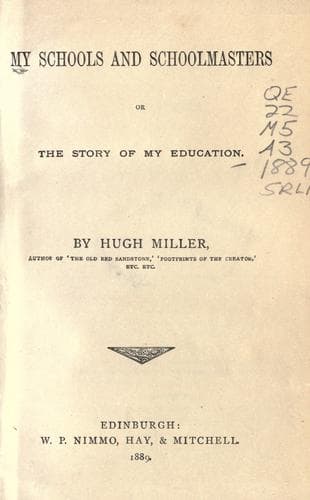
My Schools and Schoolmasters; Or, The Story of My EducationMiller, Hugh
Philosophy
My Schools and Schoolmasters; Or, The Story of My Education
Miller, Hugh
Education -- Scotland -- History -- 19th century; Geologists -- Scotland -- Biography; Miller, Hugh, 1802-1856 -- Knowledge and learning
me to con over the features of the scene, as presented in detail. At one
time a flat reach of the New Town came full into view, along which, in
the general dimness, the multitudinous chimneys stood up like stacks of
corn in a field newly reaped; at another, the Castle loomed out dark in
the cloud; then, as if suspended over the earth, the rugged summit of
Arthur's Seat came strongly out, while its base still remained invisible
in the wreath; and anon I caught a glimpse of the distant Pentlands,
enveloped by a clear blue sky, and lighted up by the sun. Leith, with
its thicket of masts, and its tall round Tower, lay deep in shade in the
foreground--a cold, dingy, ragged town, but so strongly relieved against
the pale smoky grey of the background, that it seemed another little
city of Zoar, entire in front of the burning. And such was the strangely
picturesque countenance with which I was favoured by the Scottish
capital, when forming my earliest acquaintance with it, twenty-nine
years ago.
It was evening ere I reached it. The fog of the early part of the day
had rolled off, and every object stood out in clear light and shade
under a bright sunshiny sky. The workmen of the place--their labours
just closed for the day--were passing in groups along the streets to
their respective homes; but I was too much engaged in looking at the
buildings and shops to look very discriminately at them; and it was not
without some surprise that I found myself suddenly laid hold of by one
of their number, a slim lad, in pale moleskin a good deal bespattered
with paint. My friend William Ross stood before me; and his welcome on
the occasion was a very hearty one. I had previously taken a hasty
survey of my unlucky house in Leith, accompanied by a sharp,
keen-looking, one-handed man of middle age, who kept the key, and acted,
under the town-clerk, as general manager; and who, as I afterwards
ascertained, was the immortal Peter M'Craw. But I had seen nothing
suited to put me greatly in conceit with my patrimony. It formed the
lowermost floor of an old black building, four stories in height,
flanked by a damp narrow court along one of its sides, and that turned
to the street its sharp-peaked, many-windowed gable. The lower windows
were covered up by dilapidated, weather-bleached shutters; in the upper,
the comparatively fresh appearance of the rags that stuffed up holes
where panes ought to have been, and a few very pale-coloured petticoats
and very dark-coloured shirts fluttering in the wind, gave evident signs
of habitation. It cost my conductor's one hand an arduous wrench to lay
open the lock of the outer door, in front of which he had first to
dislodge a very dingy female, attired in an earth-coloured gown, that
seemed as if starched with ashes; and as the rusty hinges creaked, and
the door fell against the wall, we became sensible of a damp,
unwholesome smell, like the breath of a charnel-house, which issued from
the interior.
Public-domain text, read in full here on John Shaqi.
Reviews
Reviews
No reviews yet
Be the first to share your thoughts on this work.
Elsewhere in the archive
Join the Discussion
Join the discussion
Sign in to leave a comment or review.
Sign InorCreate an account